
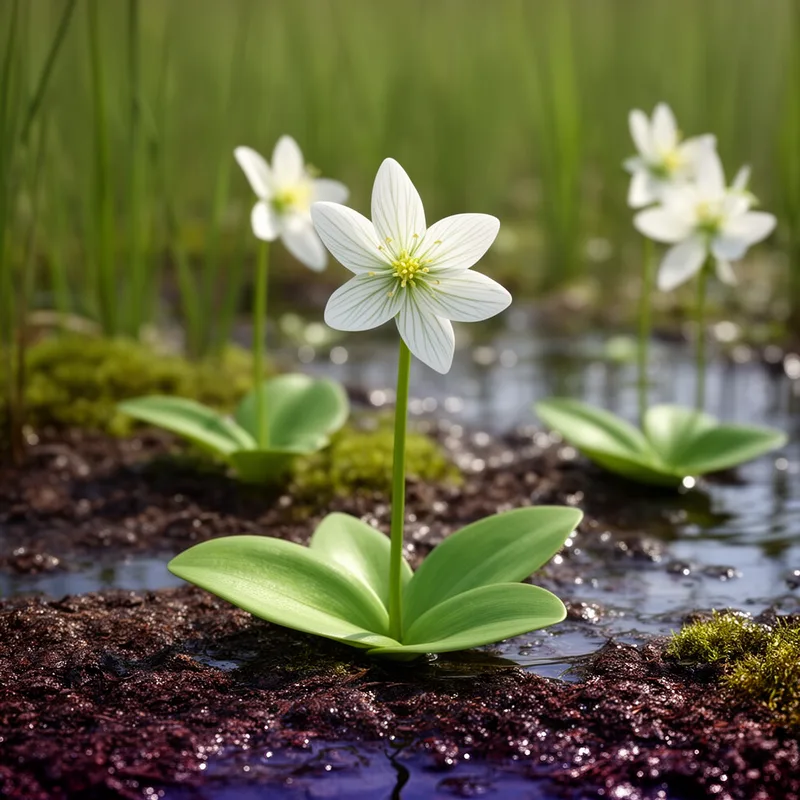
Parnassia palustris
- noun
- Specialized
- The delicate white flowers of Parnassia palustris brightened the edges of the marsh.
Examples
-
Parnassia palustris thrives in wet meadows and boggy soils throughout northern Europe and Asia.
-
Botanists admire Parnassia palustris for its intricate veining and star-shaped bloom.
-
The Parnassia palustris blooms beautifully in wetlands.
-
Have you seen the Parnassia palustris in the garden?
-
Parnassia palustris grows well in moist areas like marshes and wetlands.
-
The star-shaped flowers of Parnassia palustris can be seen blooming in boggy meadows.
-
In northern climates, Parnassia palustris adds beauty to landscape with its white flowers.
Synonyms
A small European plant with a circle of low leaves and clusters of white star-shaped flowers

A small plant with white star-shaped flowers that grows in wet places
Surface Forms
Morphology
Parnassia + palustris
This is a Latin binomial: 'Parnassia' is a genus name and 'palustris' is a Latin species epithet (not a common English word and absent from the learner's dictionary entry). A B1 learner who knows ordinary English vocabulary would not be able to derive the botanical meaning or habitat information from these constituents without specialist or Latin knowledge, so the compound is not compositionally transparent.
Etymology
Parnassia palustris is a name that mixes a place and a Latin word. Parnassia comes from Mount Parnassus in Greece, home of the 'Muses', and palustris means 'of the marsh', so the name paints a picture of a delicate white, star-shaped flower living in wet places.

