
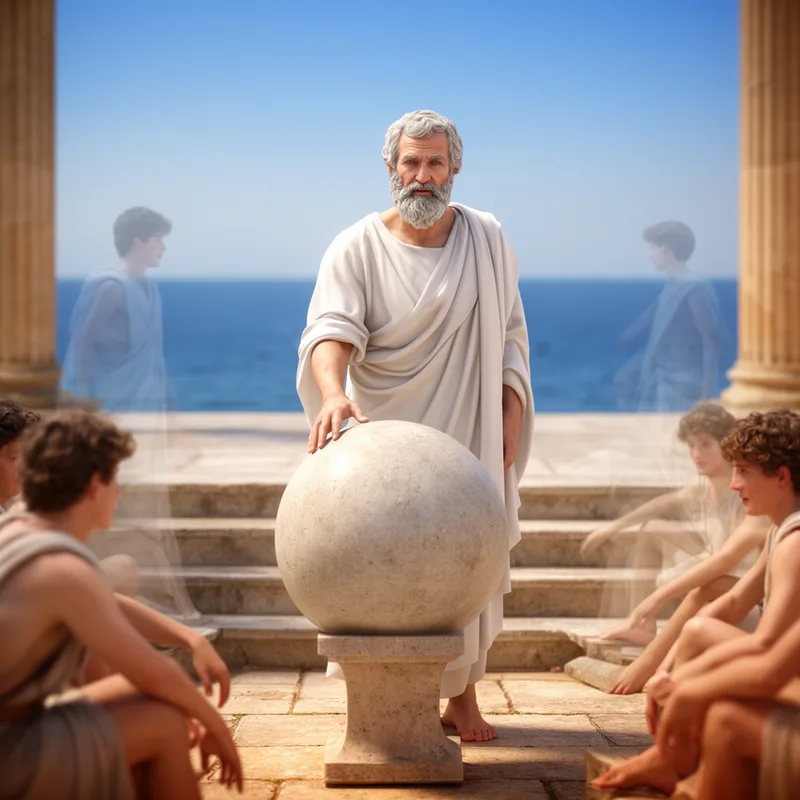
Parmenides


 1
9.9
- proper noun
- /ˌpɑːrˈmɛnɪdiːz/
- The concept of time does not surface as such in the treatment of Parmenides in the 1922 lectures.
- Parmenides and Plato
Loading YouTube…
Watch on YouTubeI mean, you know, Plato's really interested in the contrast between Heraclitus and Parmenides, right?
- I mean, you know, Plato's really interested in the contrast between Heraclitus and Parmenides, right?
- Well, for change to occur, says Parmenides, there needs to be something that at one point doesn't exist and then comes into existence.
- And that for Parmenides is sort of a sign of error sign that there's something drastically wrong there.
Examples
-
Well, for change to occur, says Parmenides, there needs to be something that at one point doesn't exist and then comes into existence.
-
The first discovery of the being of beings by Parmenides identifies being with the perceptive understanding of being.
Academic text (2017) -
The first of these aspects is the role that time plays in Parmenides' account of being.
Academic text (2017) -
In this context, he looks to Aristotle's treatment of Parmenides as a guide for his own interpretation.
Academic text (2017) -
And that for Parmenides is sort of a sign of error sign that there's something drastically wrong there.
-
At the same time, his aim in these 1922 lectures is, he insists, not to establish the degree of Parmenides' influence on Aristotle, but rather to come to some understanding of Aristotle's criticism of Parmenides.
Academic text (2017) -
Thus, with Heraclitus, the philosophic idea is to be met with in its speculative form; the reasoning of Parmenides and Zeno is abstract understanding.
Academic text (2017) -
In this way, the phenomenon of time, construed in a certain way, forms the supposition for Parmenides' way of truth, with its account of the unity, singularity, totality, and immutability of being.
Academic text (2017) -
Parmenides believed that what is not cannot even be thought, highlighting his metaphysical stance on Parmenides.
-
The philosophy of Parmenides asserts that all change is an illusion and only being is real.
Surface Forms
Etymology
Parmenides probably comes from Greek parts Parmenos and -ides, where Parmenos means 'steady' or 'remaining' and -ides means 'son of'. So a helpful way to remember him is 'son of the steady one', which fits his famous idea that true reality 'stays the same' and does not change.