
Pallas
- proper noun
- /ˈpæləs/
- Specialized
- Incidentally, Pallas did not name the blaauwbock for its blue color, but called it leucophaea (meaning dusky white) for a distinctive patch of light color under the eyes.
- Pallas (1994)
Examples
-
Pallas's persona and brilliant career well represent the ecumenicism of an admittedly small and ill-funded world of European science at the time.
Academic text (1994) -
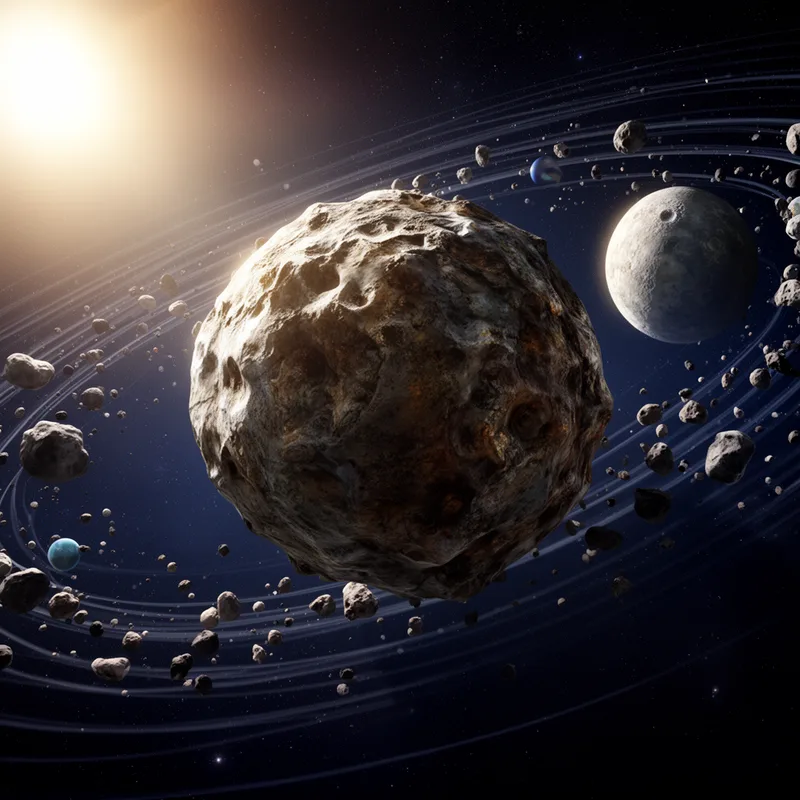
During the night sky observation, we spotted the asteroid Pallas shining brightly.
-
Buffon's specimen had been seen by Pallas in Amsterdam and had ended up in Haarlem.
Academic text (1994) -
Pallas described the blaauwbock in his Miscellanea Zoologica, published in 1766.
Academic text (1994) -
In this regard, one could argue that Ceres, Pallas, and Pluto slipped into the periodic table under false pretenses.
Academic text (2002) -
Ceres and Pallas are asteroids, not planets, and they live in the asteroid belt, now known to contain tens of thousands of objects—somewhat more than the number of elements in the periodic table.
Academic text (2002) -
You can find Asteroid Pallas located between Mars and Jupiter in the asteroid belt.
-
In 1802, astronomer Heinrich Wilhelm Olbers discovered the asteroid Pallas, which is one of the largest in the asteroid belt.
Synonyms

A very large rock that orbits the Sun in the main asteroid belt and was the second asteroid discovered
Surface Forms
Etymology
Pallas was named after the Greek goddess Pallas, another name for Athena, because astronomers often use myth figures for space names, so the large rock in the asteroid belt is called Pallas today.

