
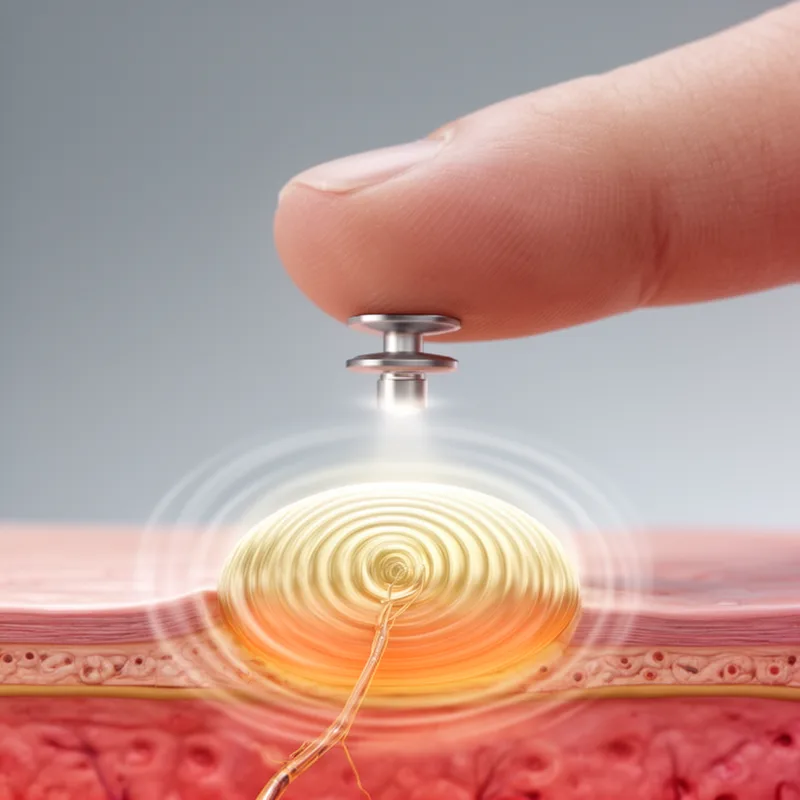
Pacinian corpuscle
- noun
- /pəˈsɪniən ˈkɔrpəsl/
- Specialized
- The Pacinian corpuscle is responsible for sensing rapid vibrations on the skin.
Examples
-
Researchers examined the distribution of Pacinian corpuscles in the fingertips.
-
A Pacinian corpuscle is sensitive to pressure changes.
-
Because a Pacinian corpuscle reacts to pressure, damage may reduce touch sensitivity.
-
The Pacinian corpuscles help us feel vibrations.
-
A Pacinian corpuscle detects vibrations in the skin, allowing us to feel different textures.
-
In areas like the palms and soles, Pacinian corpuscles help us sense pressure changes effectively.
-
The sensitivity of a Pacinian corpuscle makes it essential for perceiving rapid movements against the skin.
Surface Forms
Morphology
Pacinian + corpuscle
‘Pacinian’ is an eponym (a name) that does not convey functional meaning and ‘corpuscle’ only gives the vague idea of a 'small body.' Even if a B1 learner knew both words, they could infer it is a tiny bodily structure but would not be able to derive that it is a specialized nerve ending detecting pressure and vibration. The specific sensory function is lexicalized and not predictable from the constituents.
Etymology
Pacinian corpuscle is named after the scientist Pacinian and the word corpuscle, which means 'small body'. These tiny, round nerve endings sit deep in the skin and feel pressure and quick vibrations, so the name now refers to those pressure-sensing spots.

