
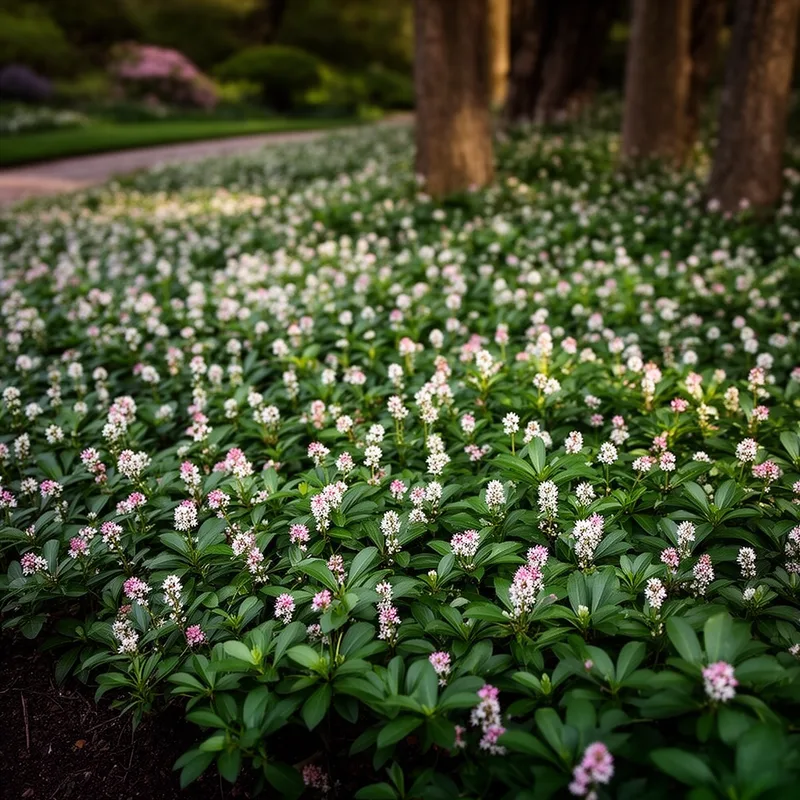
Pachysandra procumbens
- noun
- Specialized
- Gardeners often use Pachysandra procumbens as groundcover in shaded areas.
Examples
-
Native to the southeastern United States, Pachysandra procumbens has become popular in ornamental landscaping.
-
The delicate flowers of Pachysandra procumbens bloom in early spring each year.
-
The Pachysandra procumbens blooms beautifully in the spring.
-
Is the Pachysandra procumbens suitable for shady gardens?
-
Gardeners often use Pachysandra procumbens as groundcover in shaded areas.
-
Native to the southeastern United States, Pachysandra procumbens has become popular in ornamental landscaping.
-
The delicate flowers of Pachysandra procumbens bloom in early spring each year.
Synonyms
A low, partly evergreen plant with small white or pink flowers used as ground cover
A low partly evergreen plant with small white or pink flowers used as ground cover
Surface Forms
Morphology
Pachysandra + procumbens
This is a scientific binomial (genus + species) used as a taxonomic label rather than an everyday compositional phrase. One constituent ('procumbens') is a Latin epithet (not in the learner dictionary) and the genus name is a technical label, so a B1 learner who knows the parts would not be able to derive the descriptive meaning ('a low semi‑evergreen perennial herb') from them. Scientific names function as arbitrary labels across languages, making this item effectively opaque for general learners.
Etymology
Pachysandra procumbens comes from old words that describe how the plant grows: Pachysandra is the group name and procumbens means 'lying down'. The plant makes a low, spreading mat with small flowers, so gardeners use it as 'groundcover' in shady areas.

