
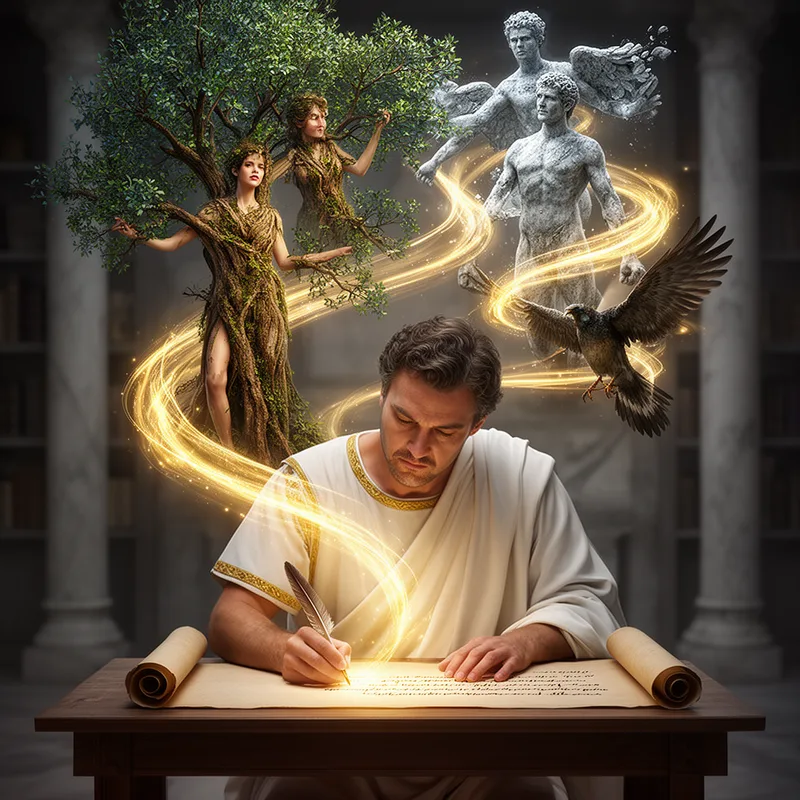
Ovidian


 1
9.9
- adjective
- /oʊˈvɪdiən/
- Literature
- Between 1757 and 1777, Ovidian themes far outweighed stories from the Iliad in the Salon.
Loading YouTube…
Watch on YouTubeI like to to describe this in Ovidian terms as a Carmen Perpetuum, A continuous song.
- I like to to describe this in Ovidian terms as a Carmen Perpetuum, A continuous song.
Examples
-
Many of the poems in the Galeria feature Ovidian themes of metamorphosis, but the latter are often just a pretext for Marino to flaunt his skills as a magician.
Academic text (2012) -
Many contemporary poets draw inspiration from Ovidian motifs in their own writings.
-
I like to to describe this in Ovidian terms as a Carmen Perpetuum, A continuous song.
-
The overlooked Ovidian connection offers an equally convincing explanation of the "enigmatic" relationship.
Academic text (1997) -
Such arguments, even if valid, do not preclude Encina's knowledge and use of Ovidian material as well.
Academic text (1997) -
In Titus, Shakespeare's changes highlight these Ovidian weaknesses.
Academic text (2000) -
Artists who illustrated these Ovidian homoerotic myths uniformly chose the noble moment of Liebestod.
Academic text (1994) -
A full understanding of the fourteenth eclogue thus requires a detailed analysis of both the explicit similarities between the Latin and Spanish texts and the way in which Encina manipulates his Ovidian model.
Academic text (1997) -
The artist's work is notable for its Ovidian themes, exploring transformation and love.
-
The Ovidian style of storytelling often incorporates rich imagery and mythological references.
Surface Forms
Morphology
Etymology
Ovidian comes from the Roman poet Ovid, who wrote the famous book 'Metamorphoses' full of stories where people change into animals, trees, or stars. So Ovidian means 'like Ovid' — imaginative and full of myth and sudden change.