
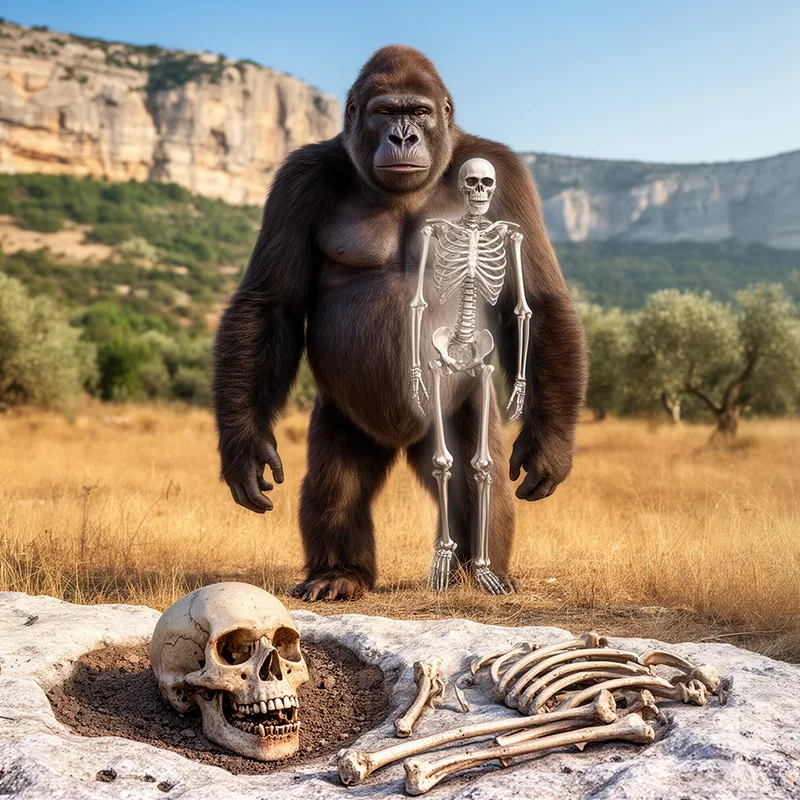
Ouranopithecus
- noun
- Specialized
- Some scientists believe that Ouranopithecus could be closely related to the ancestors of modern great apes.
Examples
-
The skeletal remains of Ouranopithecus suggest it was a large-bodied primate adapted to life on the ground.
-
Fossils of Ouranopithecus have been discovered in northern Greece, providing insight into Miocene-era primates.
-
The fossil remains of Ouranopithecus were discovered in Greece.
-
Researchers believe Ouranopithecus lived around 9 million years ago.
-
A fossil of Ouranopithecus was discovered in Greece, helping researchers learn more about ancient primates.
-
Scientists are studying Ouranopithecus to understand how early hominids evolved over millions of years.
-
The Ouranopithecus fossils provide insight into the physical characteristics of prehistoric hominids.
Surface Forms
Etymology
The word Ouranopithecus comes from Greek parts: ourano- meaning 'sky' and -pithecus meaning 'ape'. So, Ouranopithecus literally means 'sky ape', which helps you remember it is a group of ancient apes known from fossils found in Greece and nearby regions.

