
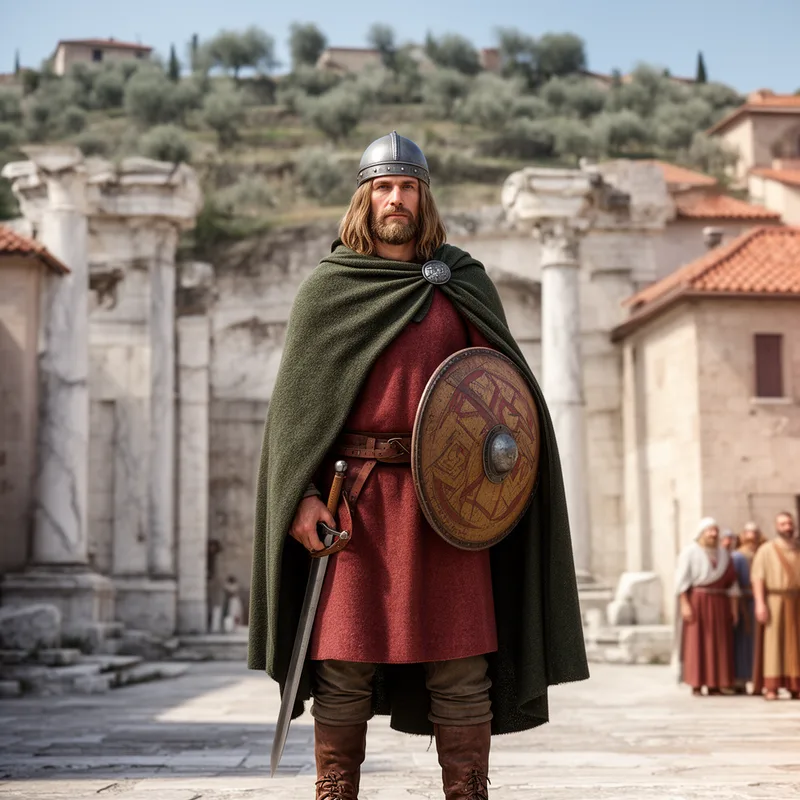
Ostrogothic
- noun
- /ˌɑstrəˈɡɔθɪk/
- The Ostrogoths established a powerful kingdom in Italy during the 5th and 6th centuries.
Loading YouTube…
Watch on YouTubeCassiodorus doesn't have any problem with the the Ostrogoths and gets along with them just just fine.
- Cassiodorus doesn't have any problem with the the Ostrogoths and gets along with them just just fine.
Examples
-
For now, Justinian has good relations with the Vandals in North Africa and the Ostrogoths in Italy.
-
Cassiodorus doesn't have any problem with the the Ostrogoths and gets along with them just just fine.
-
For now, Justinian has good relations with the Vandals in North Africa and the Ostrogoths in Italy.
-
They surely belong to the period after 540 because the Ostrogothic kings would hardly have permitted anyone to put up mosaics in their capital that glorified the emperor and empress as rulers at Ravenna.
Academic text (1997) -
Many historians study the Ostrogoths to understand the political dynamics of ancient Italy.
-
The Ostrogoths were known for their unique architectural style in the cities they controlled.
Synonyms
 1
9.9

A person from an eastern group of Goths who ruled northern Italy around 500 AD
Surface Forms
Morphology
Ostrogothic = Ostrogoth (transparent) = Ostrogoth + ic
Derived from the ethnonym 'Ostrogoth' with '-ic'; the noun sense is a nominal use of the adjective (a person related to that group).
Etymology
Ostrogothic for a person comes from Ostro- 'east' + Goth 'Goth', so an Ostrogothic is an 'eastern Goth' and means a member of that old people.