

Orycteropus afer
- noun
- Specialized
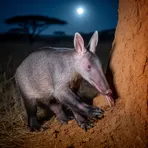
- The Orycteropus afer uses its strong claws to dig for termites at night.
Examples
-
Researchers observed the Orycteropus afer excavating extensive burrows in the African savanna.
-
The Orycteropus afer is often called the aardvark.
-
Despite its pig-like snout, the Orycteropus afer is not closely related to pigs.
-
Did you know that the Orycteropus afer primarily eats termites?
-
The Orycteropus afer uses its long tongue to extract termites from their nests.
-
At dusk, the Orycteropus afer emerges from its burrow to search for food.
-
In the wild, the Orycteropus afer plays a crucial role in controlling termite populations.
Synonyms
 11
7.4
11
7.4

A large African animal that is active at night, digs burrows, and eats ants and termites
 1
5.3
1
5.3
An animal active at night in African grasslands that lives in burrows and eats termites

A mammal in Africa that is active at night and digs burrows to eat termites
Surface Forms
Morphology
This is a Latin binomial combining the genus name (Orycteropus) with the specific epithet (afer, ‘from Africa’), so a learner who knows those constituents can infer it denotes the African species of that genus. However, recognizing that this equals the common animal name 'aardvark' and its behavioral details requires domain/taxonomic knowledge beyond basic vocabulary, so the relation is only partially transparent.
Etymology
Orycteropus afer may come from old Greek words orykter meaning 'digger' and pous meaning 'foot', plus the Latin afer meaning 'Africa'. That is why the name fits an African animal with digging feet that uses them to dig for termites at night.