
Orville Wright
 2
4.2

- proper noun
- /ˈɔrvəl raɪt/
- Wilbur and Orville Wright would go from obscurity to international sensations, then be held in contempt as obstructers of progress, and finally be acclaimed as the heroes who taught the world to fly.
Examples
-
We stand at the beginning of a new era, the Age of Flight, and the beginnings of today will be mightily overshadowed by the complete successes of tomorrow." - Orville Wright (1909)
Academic text (2003) -
But it wasn't until 1922, when Orville Wright received his last patent for the split flap, that slots and flaps really took off.
Academic text (2003) -
- Orville Wright (1903)
Academic text (2003) -
The contributions of Orville Wright to aviation changed the world forever.
-
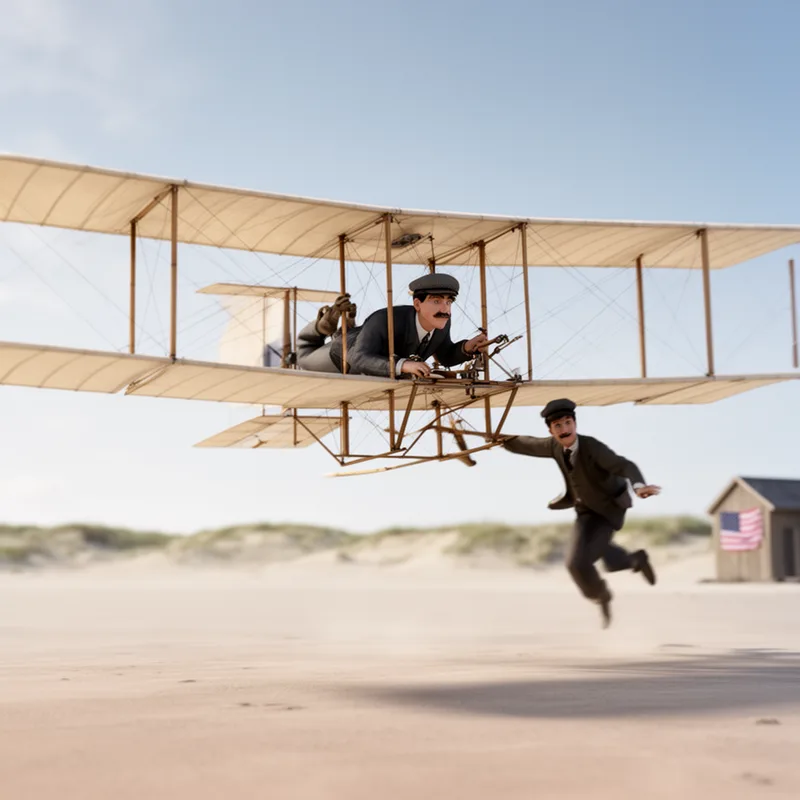
In 1903, Orville Wright and his brother made history with the first successful flight.
-
Many consider Orville Wright one of the pioneers of modern aviation.
Surface Forms
Morphology
Orville + Wright
This is a proper name referring to a specific historical individual; its meaning ('an American aviation pioneer') is not compositionally derived from the constituent words. Even if a learner knew the word 'wright' as a maker, that would not allow them to identify Orville Wright or his role, so the phrase is not predictable from its parts.
Etymology
Orville Wright was an American who, with his brother Wilbur, built a simple wooden airplane and made the 'first powered flight' in 1903. The clear picture of the brothers' first short flight helps you remember him as one of the people who helped start modern flying.