
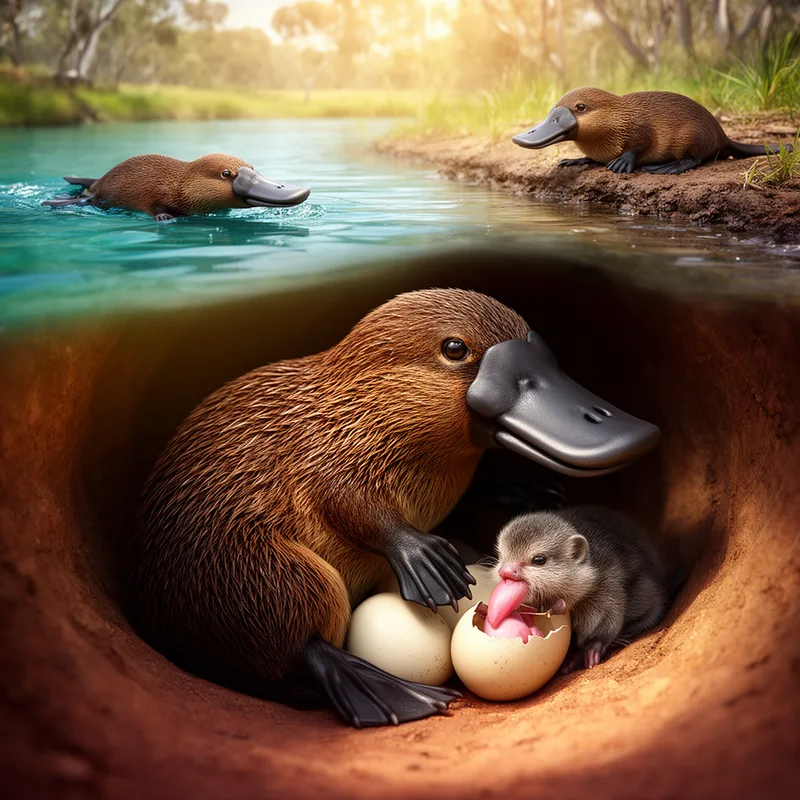
Ornithorhynchidae
- noun
- /ˌɔrnɪθəˈrɪŋkɪdi/
- Australian
- Did you know that the Ornithorhynchidae family only includes the platypus?
Examples
-
The Ornithorhynchidae family is native to eastern Australia and Tasmania.
-
Scientists study the unique characteristics of Ornithorhynchidae to understand mammalian evolution.
-
Of all monotremes, the Ornithorhynchidae are perhaps the most distinctive due to their duck-like bills.
-
The Ornithorhynchidae family is fascinating due to its unique characteristics.
-
The Ornithorhynchidae family, which includes only the platypus, is known for its unusual method of reproduction.
-
Researchers are fascinated by the Ornithorhynchidae because of their unique adaptations among mammals.
-
The Ornithorhynchidae are one of the few groups of mammals that lay eggs instead of giving birth to live young.
Surface Forms
Morphology
Ornithorhynchidae = Ornithorhynchus (opaque) = Ornithorhynchus + idae
Formed by adding the scientific family suffix '-idae' to the genus name 'Ornithorhynchus'; this is a technical taxonomic formation unlikely to be transparent to an average learner.
Etymology
The word Ornithorhynchidae comes from Greek parts: ornitho- 'bird', rhynch- 'snout', and -idae 'family'. So it literally means the 'bird-snout' family, a useful image because the platypus has a duck-like bill and is the only member of this family.

