
Orion
 18
5.6

- proper noun
- /oʊˈraɪən/
- People who have never looked up will be surprised at how Orion and Ursa Major jump out.
- Orion Nebula
- Orion constellation
- stars of Orion
Loading YouTube…
Watch on YouTubeSo it'd be the shoulder and head star of Orion, right?
- So it'd be the shoulder and head star of Orion, right?
- So you go to the Great Pyramid and you access the information of Mintaka, which is the star, one of the stars in in Orion's belt.
- If the same alien species, right, that made or told people to build things in in alignment with Orion.
- So let's go back to the Orion constellation, and let's go back to that fuzzy little BLOB in his sword.
- They're in line with, oh, I don't know the terminology, but it's like the Orion belt, which is like a star, like a group of stars.
Examples
-
So you can find Orion, turn away from there.
-
It's that little blue, little blue one on the foot of Orion.
-
"Have you taken a look at Orion lately?" Not really, but I know I should.
Fiction book (2000) -
If I succeed, I may send you a sign when Orion again becomes the darling of your night sky.
Fiction book (2000) -
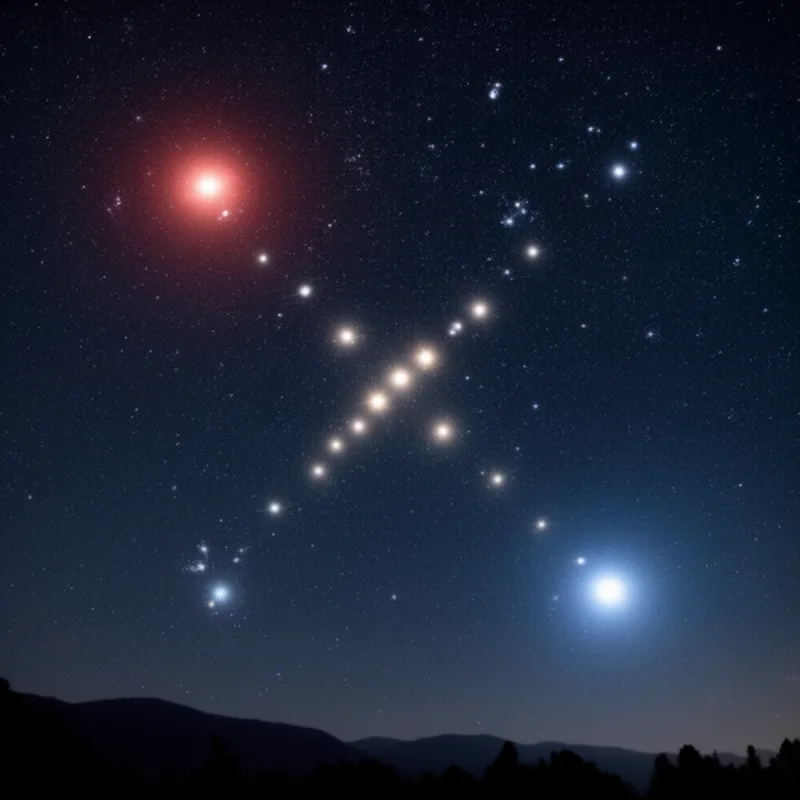
This is the picture of the constellation of Orion, the three belt stars, the legs and the arms.
-
The proof lies all around us, and nowhere more strikingly than in the Orion Nebula.
Academic text (1991) -
There you will find Orion, Cassiopeia, and Cygnus, along with the stars Alphard and Pollux.
Academic text (2007) -
If you start at Orion's belt and move down to Orion's foot, that's Rigel.
-
Here's the Orion constellation, the middle star in the sword that's hanging down from Orion's belt.
-
As the night sky darkened, we spotted the constellation Orion rising above the horizon.
Surface Forms
Etymology
Orion comes from an old Greek name for a bright group of stars, and today it names the famous constellation. A helpful way to remember it is to think of the name like orient, which relates to 'rising' or 'east', so Orion is the star figure you can see rise in the night sky.