
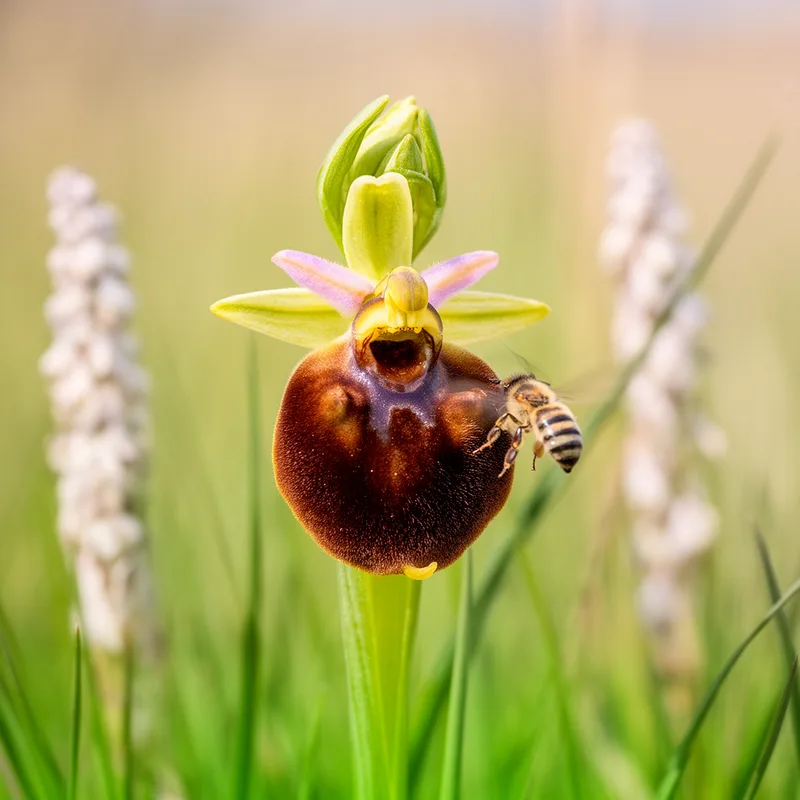
Ophrys sphegodes
- noun
- Specialized
- Botanists note that the lip of Ophrys sphegodes mimics the appearance of a spider to attract pollinators.
Examples
-
The Ophrys sphegodes can be found growing wild in chalk grasslands across southern England.
-
Many photographers travel each spring to capture the delicate beauty of Ophrys sphegodes in bloom.
-
The Ophrys sphegodes blooms beautifully in spring.
-
Many gardeners love the Ophrys sphegodes for its unique appearance.
-
The Ophrys sphegodes is known for its striking resemblance to a spider, which helps it attract bees for pollination.
-
During the spring season, enthusiasts eagerly hunt for the rare Ophrys sphegodes in their natural habitats.
-
In southern Europe, the Ophrys sphegodes can often be seen flourishing in its native chalk grasslands.
Synonyms

An orchid that flowers in spring with pale outer petals and a large brown soft middle petal
Surface Forms
Morphology
Ophrys + sphegodes
This is a Latin binomial (scientific species name) where the form functions as a label rather than a compositional phrase; knowing the genus name 'Ophrys' and an unknown specific epithet 'sphegodes' does not let a B1 learner derive the detailed meaning (spring-blooming spider orchid with specific colours). Taxonomic names are language-neutral identifiers and their semantic content (habitat, appearance) is not predictable from the constituents, so the expression is not transparent.
Etymology
Ophrys sphegodes may come from old Greek words: Ophrys meaning 'brow' and sphegodes meaning 'wasp-like'. One popular story says the flower's dark, furry lip looks like an insect and tricks male insects into visiting, so the name points to its insect-like look today.

