
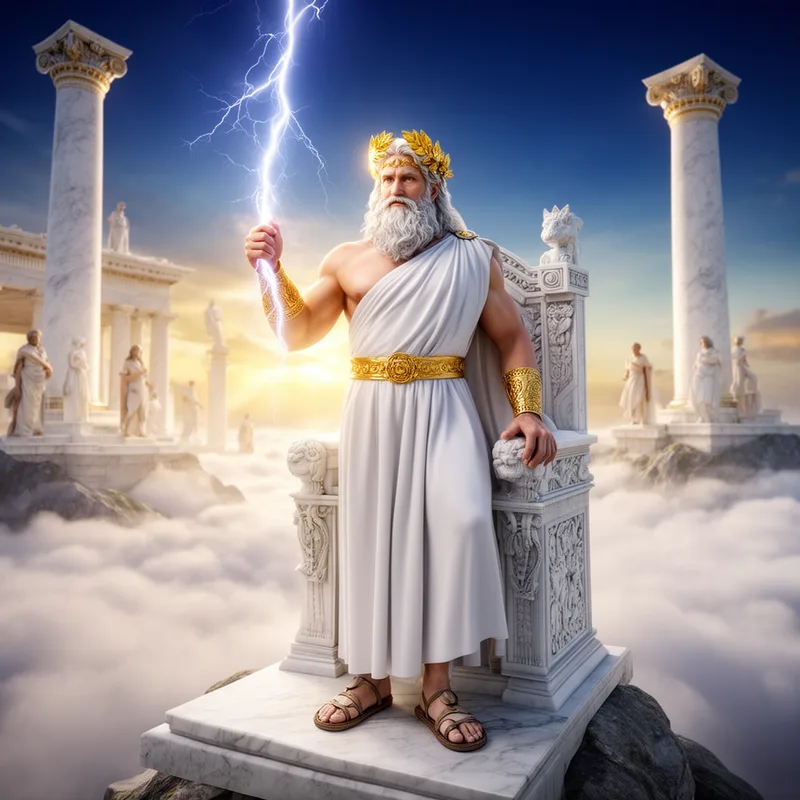
Olympic god
- noun
- /əˈlɪmpɪk ɡɑd/
- Literature
- Zeus is perhaps the most famous Olympic god in Greek mythology.
Examples
-
The ancient Greeks believed each Olympic god had unique powers and responsibilities.
-
The Olympic gods played a vital role in Greek mythology.
-
Hera, an Olympic god, was known as the queen of the gods.
-
Zeus is considered the most powerful Olympic god.
-
Zeus is the king of the Olympic gods who ruled from Mount Olympus.
-
Hera, the wife of Zeus, is one of the most revered Olympic gods in ancient Greek religion.
-
Each Olympic god represented different aspects of life and nature in Greek mythology.
Synonyms

 1
8.1
1
8.1

One of the main Greek gods who live on Mount Olympus
Surface Forms
Morphology
The meaning 'one of the principal gods of Mount Olympus' is directly and compositionally derived from 'Olympic' (of or relating to Olympia/Olympus) + 'god' (a deity). Although 'Olympic' is often encountered in the context of the modern Games, the phrase follows a straightforward modifier+noun pattern found across languages, so a B1 learner who knows both words should be able to infer the MWE meaning.
Etymology
Olympic god comes from the picture of the main Greek gods living together on Mount Olympus, a high mountain. After they beat the older gods, these powerful beings were said to live on that mountain, so the phrase means 'one of the main gods who lives on Mount Olympus'.