
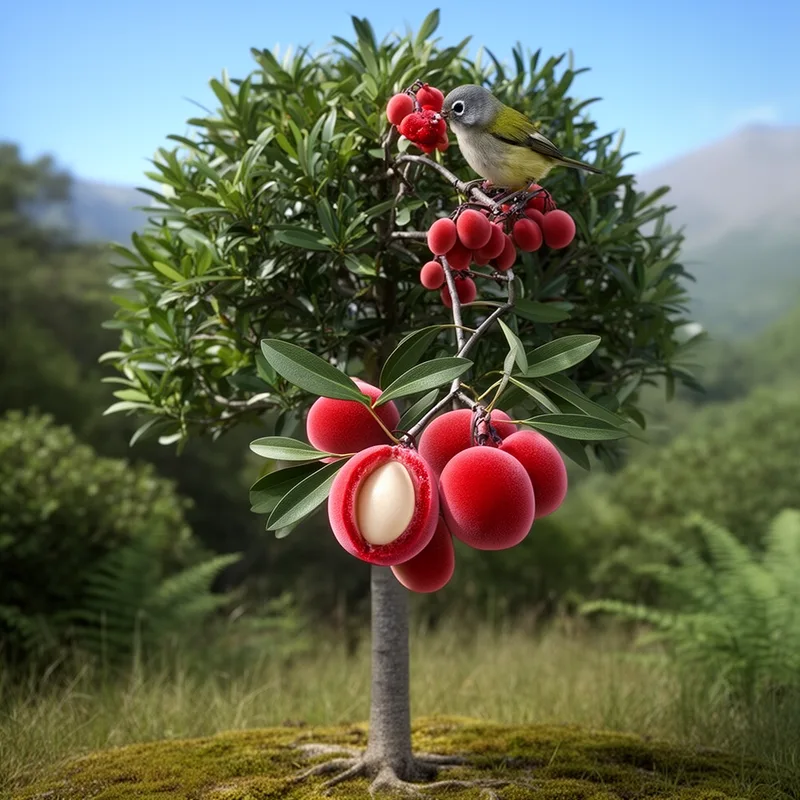
Olea lanceolata
- noun
- Specialized
- The Olea lanceolata is appreciated for its attractive red fruits in native New Zealand gardens.
Examples
-
In native gardens, the Olea lanceolata stands out for its vibrant red, pulpy fruit that attracts wildlife.
-
Birds often feed on the ripe fruit of the Olea lanceolata during the summer months.
-
Botanists recently discovered a mature Olea lanceolata growing near the forest edge.
-
The Olea lanceolata tree produces beautiful red fruit.
-
Can you identify the Olea lanceolata in the garden?
-
During my visit to New Zealand, I noticed that the Olea lanceolata was thriving, its red fruit drawing many birds.
-
The small tree known as Olea lanceolata is well-regarded for its one-seeded, bright red fruits, especially in summer.
Synonyms
A small New Zealand tree with bright red fruit that has one seed
Surface Forms
Morphology
Olea + lanceolata
This is a Latin binomial: 'Olea' names the olive genus and 'lanceolata' (related to 'lanceolate') describes a lance-shaped form, so a learner who knows both constituents could infer an olive-relative with lance-shaped leaves. However, the precise referent (a small New Zealand tree with red, pulpy, one-seeded fruit) and the taxonomic nature of the label are not fully predictable from the parts, and 'lanceolata' is not common B1 vocabulary, making the connection only partial.
Etymology
Olea lanceolata comes from Latin words: Olea means 'olive' and lanceolata means 'spear-shaped', showing its long pointed leaves. So the name gives a clear picture—a small olive-like tree with long leaves and red, pulpy, one-seeded fruit native to New Zealand—which helps you remember what the plant is today.

