
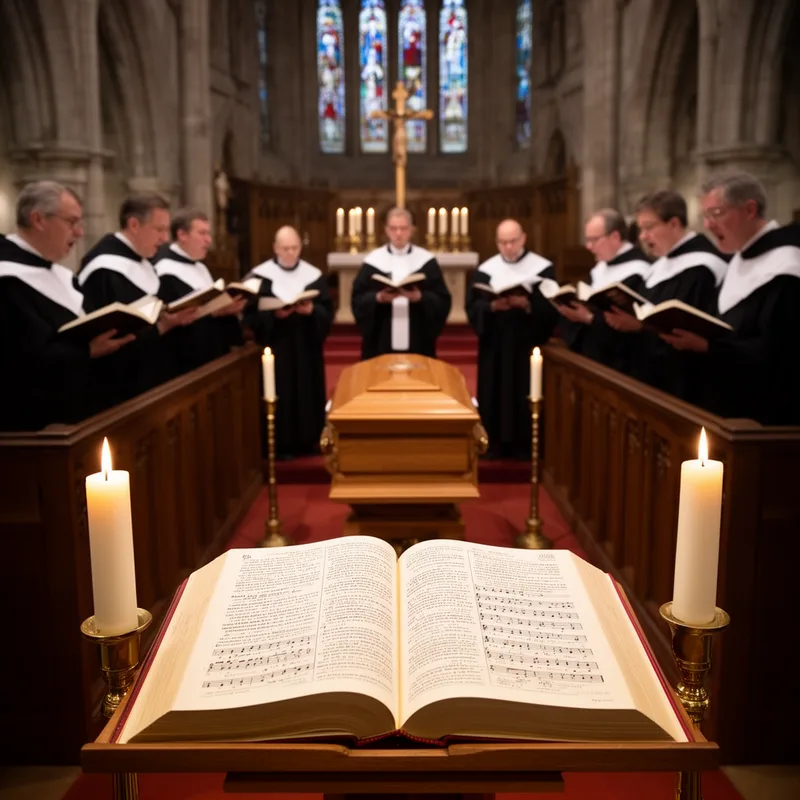
Office of the Dead
- noun
- /ˈɔfɪs əv ðə dɛd/
- Formal
- During All Souls' Day, the Office of the Dead is often recited in monasteries.
Examples
-
The choir sang the Office of the Dead before the funeral mass began.
-
He composed a musical setting for the Office of the Dead in memory of his teacher.
-
The Office of the Dead is essential.
-
Many families choose to hold the Office of the Dead before the burial.
-
During the funeral service, the priest led the congregation in the Office of the Dead to honor the deceased.
-
Many families choose to include the Office of the Dead as part of the memorial rituals for their loved ones.
-
The church organizes a special ceremony each year that features the Office of the Dead to pray for those who have passed away.
Synonyms

 31
9.0
31
9.0

A church service that follows set words and actions

A ceremony held for a dead person to honour them
Surface Forms
Morphology
The phrase combines 'office' (a canonical liturgical service) with 'the dead' (those deceased), so its meaning—a prayer/service for the dead—is directly and compositionally derivable from the constituents. This pattern is common cross-linguistically (e.g. Spanish 'Oficio de Difuntos'), so a B1 learner who knows the provided senses would readily understand it.
Etymology
Office of the Dead comes from old church language where the word office meant a set of prayers and readings, and those prayers were said for the dead before a burial or on special days. So the name means 'a church service of prayers and readings for people who have died'.