
Nsibidi
- noun
- /nəˈsiːbɪdi/
- A woman wearing print cloth with a pattern of conjoined arcs, the nsibidi sign for love.
Examples
-
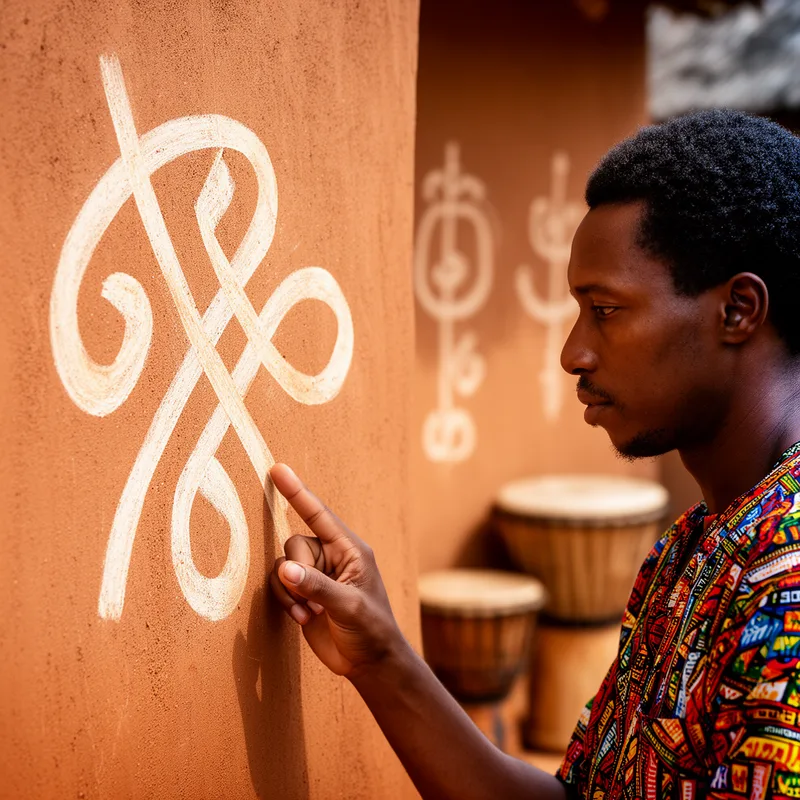
Nsibidi signs can be drawn in the air (as gestures) or on the ground, as well as on skin (as tattoos), houses, and art forms, such as masks and textiles (Fig. 13).
Academic text (2007) -
The nsibidi characters convey important messages about identity and heritage among the Ejagham people.
-
Like many other African writing systems, nsibidi is often used to mediate social relationships rather than to simply document ideas and information.
Academic text (2007) -
Their torsos are painted with nsibidi designs.
Academic text (2007) -
For a long time, messages have been sent in Nsibidi script, cut or painted on split palm stems.
Academic text (2007) -
Nsibidi was also displayed in the homes of Leopard Society members.
Academic text (2007) -
In Calabar today, nsibidi is generally associated with the men's Leopard Societies.
Academic text (2007) -
NSIBIDI is an ancient system of graphic communication indigenous to the Ejagham peoples of southeastern Nigeria and southwestern Cameroon in the Cross River region.
Academic text (2007) -
It is possible that the Nsibidi writing was developed among its members as a method of communication or, perhaps with greater likelihood, its use was kept up by them long after it had been forgotten outside their circle (P.A. Talbot 1969:792).
Academic text (2007) -
Nsibidi symbols are often carved into wooden masks used in traditional ceremonies in southeastern Nigeria.
Surface Forms
Etymology
Nsibidi comes from a local language in southeastern Nigeria and the name refers to the special signs used there, often called 'symbols' or 'messages'. A single Nsibidi is one of those signs that can stand for a word, idea, or message.

