
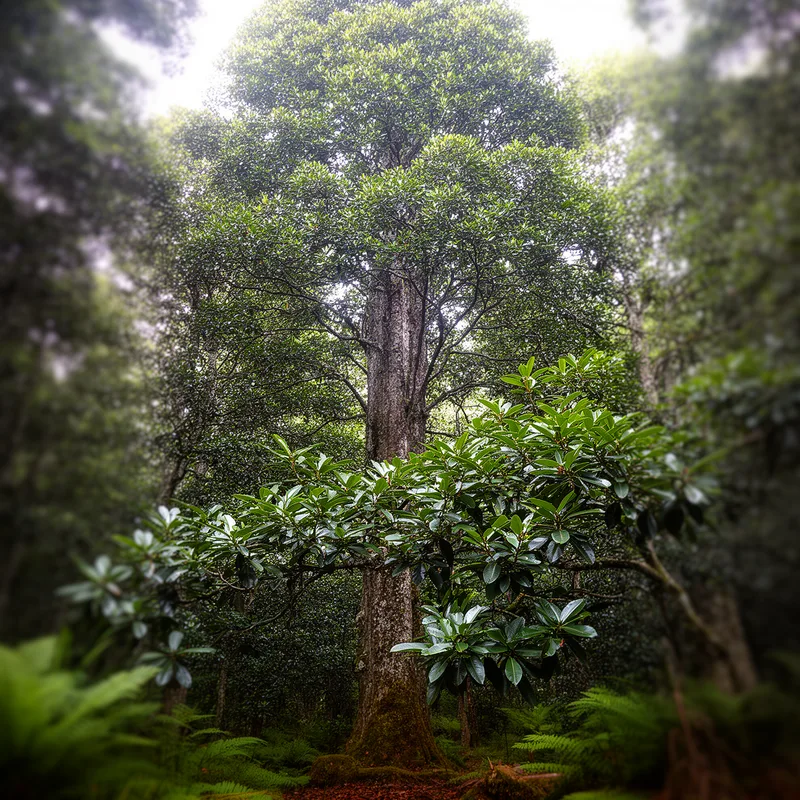
Nothofagus cunninghamii
- noun
- Specialized
- The dense forests of Tasmania are dominated by Nothofagus cunninghamii, also known as myrtle beech.
Examples
-
The leaves of Nothofagus cunninghamii are small, glossy, and evergreen, providing year-round foliage.
-
In Tasmania, Nothofagus cunninghamii thrives in cool, moist forests.
-
Researchers studied the growth patterns of Nothofagus cunninghamii to understand Tasmania’s ecosystem.
-
The Nothofagus cunninghamii is a majestic tree.
-
The dense forests of Tasmania are dominated by Nothofagus cunninghamii, also known as myrtle beech.
-
In Tasmania, Nothofagus cunninghamii thrives in cool, moist forests.
-
Researchers studied the growth patterns of Nothofagus cunninghamii to understand Tasmania’s ecosystem.
Synonyms

A large evergreen tree from Tasmania with dark shiny leaves and wood used for furniture
Surface Forms
Morphology
Nothofagus + cunninghamii
This is a Latin binomial: knowing 'Nothofagus' (the southern beech genus) lets a learner infer the phrase names a type of Nothofagus tree, so part of the meaning is compositional. However, the species epithet 'cunninghamii' is a non-lexical Latinized name (not interpretable as an English word) and does not convey attributes like 'large evergreen' or 'myrtle beech', so the full referent cannot be derived by a B1 learner.
Etymology
Nothofagus cunninghamii comes from old Greek words and from the name of a botanist. The first part, nothos + fagus, means 'false beech' because the tree looks like a beech but is different, and cunninghamii honors the plant collector Allan Cunningham, so the name tells us what the tree looks like and who it remembers.

