
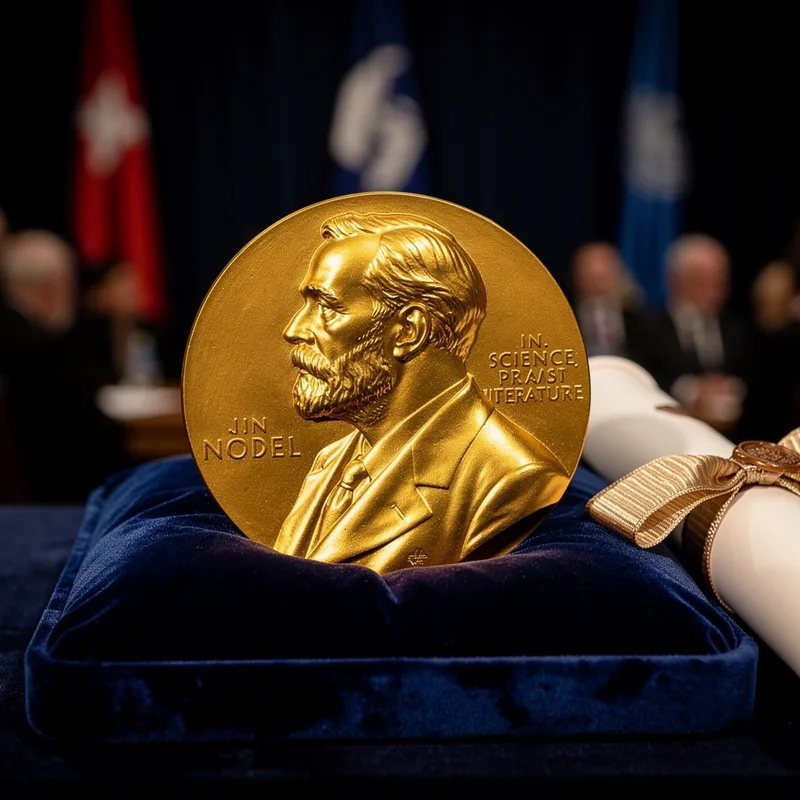
Nobel
 170
4.2
170
4.2

- proper noun
- /ˈnoʊbəl/
- And again, I'm so proud to tell you today that it was announced that she won the Nobel Peace Prize today.
- Nobel Prize
- Nobel laureate
- Nobel Prize in Physics
Loading YouTube…
Watch on YouTubeAnd you know, I was, let's put it this way, when I watched her Nobel lecture.
- And you know, I was, let's put it this way, when I watched her Nobel lecture.
- And again, I'm so proud to tell you today that it was announced that she won the Nobel Peace Prize today.
- Like, OK, just as a sort of if you look at the amount of Nobel Prizes they won in science, why were they so darn smart?
- I mean, it was amazing how many Nobel Prizes England was winning in chemistry and physics and biology and all the sciences.
- It has not yet won anyone a Nobel Prize, but maybe it soon will.
- This year's Nobel Prizes gave us a taste of this.
- Oh, man, Duda, I don't think you are going to win the Nobel Priest Prize.
- Nobel Peace Prize dynamite, destructive dynamite, but Nobel Peace Prize.
Examples
-
In 1936, Anderson received the Nobel Prize in Physics "for his discovery of the positron."
Academic text (2012) -
She was honored with the Nobel Prize for her groundbreaking research in environmental science.
-
You enjoyed, I hope, the title why women won the Nobel Peace Prize.
-
And we'll get the Nobel Prize.
-
There is no Nobel Prize in mathematics.
-
She won the Nobel Prize for her research on flying mammals.
-
In 1934, Urey was awarded the Nobel Prize in Chemistry "for his discovery of heavy hydrogen."
Academic text (2012) -
In 1978, at the age of 74, Isaac Bashevis Singer received the Nobel Prize in Literature.
Fiction book (1999) -
In 1984, he received the Nobel Prize for Literature for his outstanding contributions to modern poetry.
-
The Nobel Prize committee recognized his efforts in promoting peace and humanitarian work.
Compounds

 5
2.8
5
2.8
An annual international award for important work in science, literature, economics, or peace
- Informal
A tendency for very successful people to become overconfident and support unusual controversial ideas after fame
Surface Forms
Etymology
Nobel as an adjective means 'connected to the prizes founded by Alfred Nobel', so a 'Nobel' ceremony or 'Nobel' winner is something that comes from the awards he set up.