
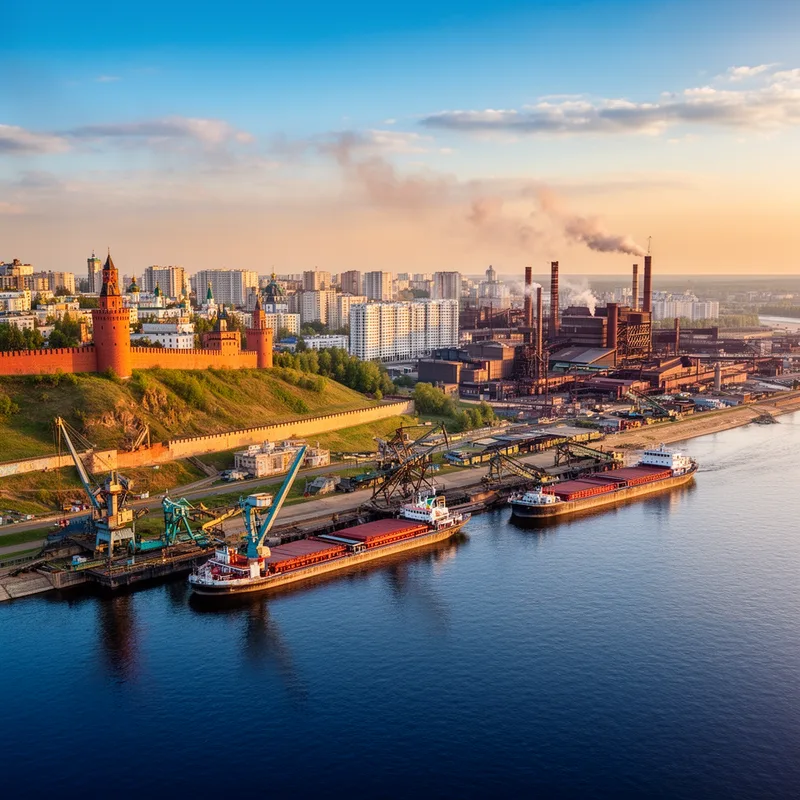
Nizhni Novgorod
 1
7.9

- proper noun
- /ˈnɪʒni ˈnɔvɡərəd/
- Nizhni Novgorod is famous for its rich history.
Examples
-
I visited Nizhni Novgorod last summer.
-
She was born in Nizhni Novgorod, one of Russia's oldest and most important industrial cities.
-
Many tourists visit Nizhni Novgorod to see its historic Kremlin and beautiful river views.
-
The company is opening a new office in Nizhni Novgorod to expand its business in Russia.
-
The historical architecture in Nizhni Novgorod attracts many tourists every year.
-
The city of Nizhni Novgorod is known for its innovative manufacturing industries.
-
Located on the Volga River, Nizhni Novgorod plays a vital role in Russia's economy.
Synonyms
 1
8.1
A large Russian city by the Volga and Oka rivers that has factories, old buildings, and museums
A large industrial city in western Russia where the Volga and Oka rivers meet
Surface Forms
Morphology
Nizhni + Novgorod
The headword is a toponym whose parts are compositionally meaningful: 'Novgorod' is clearly a place-name and 'Nizhni' corresponds to Russian 'lower', so a learner who knows both constituents could infer it denotes a location (literally 'Lower Novgorod'). However, the full encyclopedic sense (an industrial city on the Volga, birthplace of Gorky) is not derivable from the parts, and 'Nizhni' is not an English lexical item—so understanding depends on cross-linguistic knowledge and does not give the detailed meaning.
Etymology
Nizhni Novgorod comes from old Russian words: Nizhni meaning 'lower' and Novgorod meaning 'new town'. The name likely described its position down the Volga River, so it helps you remember the city is the 'lower new town' by the river and today is an important industrial centre.