
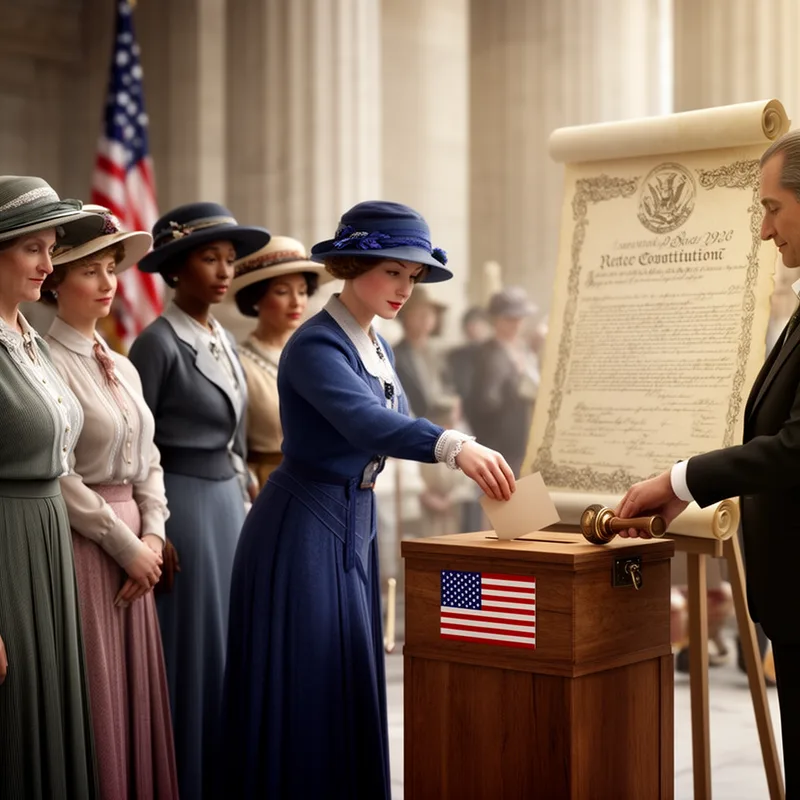
Nineteenth Amendment


 1
4.9
1
4.9
- noun
- /ˈnaɪnˌtiːnθ əˈmɛndmənt/
- US
- True, for the period ending in 1919, women did move into jobs previously closed to them, but by 1920 (the same year in which the Nineteenth Amendment was adopted) they made up a smaller percentage of the labor force than they had in 1910.
Examples
-
In 1920, the Nineteenth Amendment, which prohibited restrictions based on a person's sex, was enacted.
Blog text (29) -
The trend to invoke the Declaration continued into 1920 with the ratification of the Nineteenth Amendment, securing the right to vote for women.
Blog text (23) -
As president in 1919 and 1920, she lobbied the state legislature in favor of the passage of the Nineteenth Amendment.
Academic text (2003) -
During the past twelve months, I met the great-granddaughter of one of the suffragists who helped to get the Nineteenth Amendment to the US Constitution (giving women the right to vote) passed.
Blog text (28) -
However, in 1919, after years of petitioning, picketing, and protest parades, the Nineteenth Amendment was passed by both houses of Congress, and in 1920 it became ratified under the presidency of Woodrow Wilson.
Blog text (15) -
The National Association Opposed to Woman Suffrage (NAOWS) formed in 1911 in New York in opposition to the Susan B. Anthony Amendment, which became the Nineteenth Amendment to the U.S. Constitution that prohibited both state and federal governments from denying any citizen the right to vote based on gender.
Academic text (2009) -
In 1920, the Nineteenth Amendment granted women the right to vote in the United States.
-
The passage of the Nineteenth Amendment in 1920 marked a significant victory for the women's suffrage movement.
-
With the Nineteenth Amendment ratified in 1920, women could no longer be denied the right to vote based on their sex.
Synonyms
A change to the United States Constitution made in 1920 that gives women the right to vote
Surface Forms
Morphology
The phrase transparently combines 'nineteenth' (an ordinal) and 'amendment' (a formal change), so a learner who knows both words can infer it refers to the 19th amendment in a legal or constitutional context. However, the specific referent and content (that it guarantees women's suffrage in the U.S. and its historical details) cannot be derived from the constituents alone, making the expression only partially predictable.
Etymology
The Nineteenth Amendment is named because it was the nineteenth amendment, or change, to the U.S. Constitution after a long fight by women for the vote. When it was officially added in 1920, it made it illegal for states to refuse women the right 'to vote', so the name now refers to the rule that makes sure women can vote.