

Nilotic


 1
9.5
- adjective
- /nɪˈlɒtɪk/
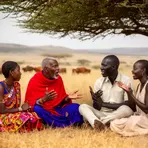
- The tall, graceful figures of the Nilotic people are often seen on the banks of the Nile River.
- Nilotic people
Examples
-
This ideological claim, which has a dubious scientific basis, places the Hutu among the Bantu and the Tutsi among the Hamitic/Nilotic peoples.
Academic text (2004) -
Atta and El Khider (2004) reported that the male lambs of Nilotic sheep have a higher value for height at wither than female lambs.
Academic text (2014) -
Although the 1956 census was conducted more professionally, figures for highly mobile Nilotic communities remain open to considerable doubt.
Academic text (1990) -
But Nilotic conservatism has been grossly exaggerated.
Academic text (1998) -
This is particularly interesting in view of the campaign initiated among Congolese and African elites claiming that a profound division and antagonism exists among Africans of Bantu as against Hamitic or Nilotic backgrounds.
Academic text (2004) -
Many Nilotic tribes traditionally depend on the Nile River for their livelihoods.
-
The study focused on the Nilotic communities and their unique cultural practices along the Nile.
Compounds
- Specialized
1
9.9
A language spoken in East Africa by groups such as the Maasai and Dinka
Surface Forms
Morphology
Etymology
Nilotic comes from the name Nile and the ending -otic, which together mean 'of the Nile'. That is why Nilotic can describe people, culture, or artifacts from the lands along the Nile river.