
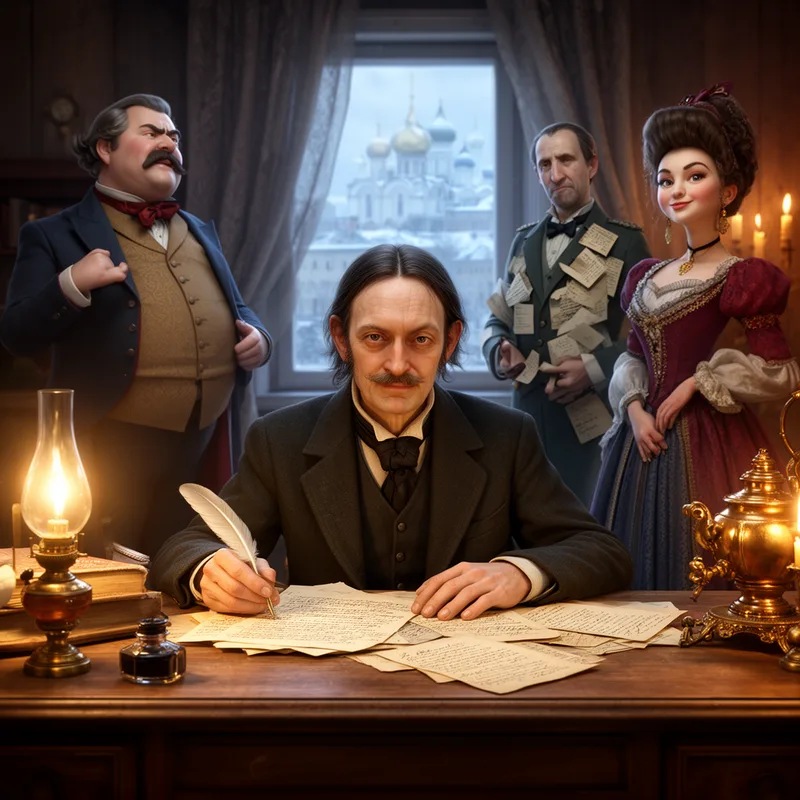
Nikolai Vasilievich Gogol
- proper noun
- Literature
- Many scholars study Nikolai Vasilievich Gogol to understand the origins of literary realism.
Examples
-
The satirical stories of Nikolai Vasilievich Gogol have influenced generations of writers.
-
Many consider Nikolai Vasilievich Gogol a pioneer of Russian realism.
-
Nikolai Vasilievich Gogol is regarded as a founding figure in Russian literature.
-
Have you read Nikolai Vasilievich Gogol's works?
-
Nikolai Vasilievich Gogol is known for his contributions to Russian literature, particularly with the novel 'Dead Souls'.
-
The humor and satire in Nikolai Vasilievich Gogol's stories have marked him as a significant figure in literary history.
-
Many admire Nikolai Vasilievich Gogol for shaping the narrative style of modern Russian fiction.
Synonyms

 5
6.5

A Russian writer from the 1800s who wrote funny, sharp stories like The Overcoat and Dead Souls


 1
6.6
A Russian writer from the 1800s who wrote stories like The Overcoat and the novel Dead Souls
Surface Forms
Morphology
Nikolai + Vasilievich + Gogol
This is a full proper name whose referential identity and biographical information (that he is a noted Russian writer) are not compositionally derivable from the constituent words. Even if a learner recognises 'Nikolai' or the patronymic pattern '-vich', that does not allow them to infer the specific fact that Gogol was a pioneering realist author, so the expression is not transparent.
Etymology
Nikolai Vasilievich Gogol is the famous Russian writer known for short stories that mix the strange, the funny, and the sad. Think of his story 'The Overcoat', where a poor clerk loses his coat and his life falls apart, and you can see why his name is linked to writing about 'real life' and social problems today.