
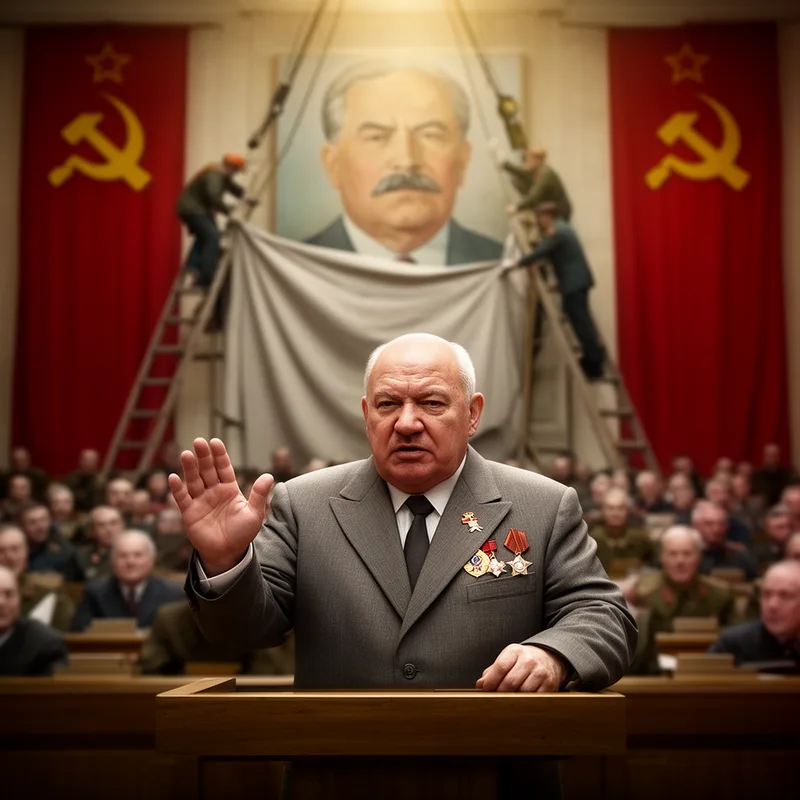
Nikita Khrushchev
 7
5.4

- proper noun
- /nɪˈkɪtə ˈkrʊʃtʃɛf/
- During the Cuban Missile Crisis, Nikita Khrushchev played a crucial role in negotiating with the United States.
Examples
-
What do you know about Nikita Khrushchev?
-
Nikita Khrushchev delivered his famous secret speech denouncing Stalin's crimes in 1956.
-
Many historians credit Nikita Khrushchev with beginning the process of de-Stalinization in the Soviet Union.
-
Nikita Khrushchev was a significant leader.
-
Nikita Khrushchev served as the Nikita Khrushchev premier of the Soviet Union from 1953 to 1964, during a time of significant political change.
-
Known for his strong stance against Stalin, Nikita Khrushchev played a crucial role in the movement to de-Stalinize the Soviet Union.
-
During the Cold War, Nikita Khrushchev was famous for his bold statements and actions, such as his visit to the United States in 1959.
Synonyms
 44
7.9
Soviet leader known for speaking against Stalin and starting reforms
A Soviet leader who led the country in the 1950s and early 1960s during the Cold War
Surface Forms
Morphology
Nikita + Khrushchev
This is a proper name whose meaning (a Soviet leader and historical figure) depends on world knowledge rather than compositional semantics; knowing the parts 'Nikita' and 'Khrushchev' as words does not allow a learner to infer the biographical information. Proper names are referential and language-specific, so a B1 learner who only knows the constituent words would not be able to derive the MWE's meaning.
Etymology
Nikita Khrushchev was the Soviet leader who shocked many when he openly said in 1956 that Stalin had done terrible things. He later faced the United States in a dangerous missile standoff over Cuba, so his name now often reminds people of 'a bold, outspoken leader who changed Soviet policy and stood up to the West'.