

New World blackbird
- noun
- /nuː wɜrld ˈblækˌbɜrd/
- US
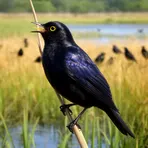
- Male New World blackbirds often display their glossy black feathers to attract mates during breeding season.
Examples
-
Unlike the European blackbird, the New World blackbird belongs to the Icteridae family.
-
The New World blackbird is known for its distinctive song.
-
Male New World blackbirds often have glossy black feathers that stand out during mating season.
-
The New World blackbird is common in wetlands across North America.
-
Many New World blackbirds can be found in wetlands.
-
The New World blackbird is typically seen foraging for insects in marshes throughout North America.
-
With their striking black plumage, New World blackbirds are a familiar sight in many American parks.
Synonyms
 5
2.7
5
2.7

A North or Central American songbird whose male has shiny black feathers
Surface Forms
Morphology
The phrase is transparently compositional: 'New World' denotes the Americas (a geographic modifier) and 'blackbird' denotes a black songbird, so together they mean a blackbird native to the New World. This straightforward noun–noun combination follows common cross-linguistic patterns, so a B1 learner who knows the constituent meanings can reasonably infer the MWE meaning.
Etymology
New World blackbird comes from a simple picture: New World was what early explorers called the 'Americas', and blackbird points to the shiny, mostly black males people saw. So today the name refers to a group of birds from the Americas whose males are often black.