
New Netherland


 1
8.0
- proper noun
- Clearly, the law and custom of Holland applicable in New Netherland in 1645, when a town charter was granted for Flushing, was no longer what had been conceived in 1579.
- Description of New Netherland
Examples
-
Additionally, consistent with the policy aiming to preserve Reformed social unity, Lutherans in New Netherland were forbidden to hold meetings led by their minister, who was also deported.
Academic text (2010) -
But we do not see this tolerance as a dominant attitude in the Reformed Church, whether in The Netherlands or in New Netherland; and it is just as difficult to find it generally outside the great cities of Holland.
Academic text (2010) -
These English from Flushing in New Netherland were not Quakers themselves.
Academic text (2010) -
The Reformed ministers in New Netherland were not enthusiastic about the arrival of the Jews either.
Academic text (2010) -
New Netherland did not tolerate Lutheran services, for example, until the English took over.
Academic text (2010) -
But regardless of the situation in Pennsylvania, women were an integral part of relations between Indians and colonists in New Netherland and New York.
Academic text (2010) -
New Netherland's authorities allowed Quakers and their supporters the liberty to retain their beliefs and to choose to be scourged.
Academic text (2010) -
Jacobs concludes, "The decision to allow the Jews to stay in New Netherland, despite the opposition of ministers, the director general and council, and the colonists, was a consequence of the tolerant views of the directors in Amsterdam."
Academic text (2010) -
Jaap Jacobs comments in his recent scholarly survey of the history of the colony that "No one in New Netherland was pleased with the arrival of twenty-three destitute Jews."
Academic text (2010) -
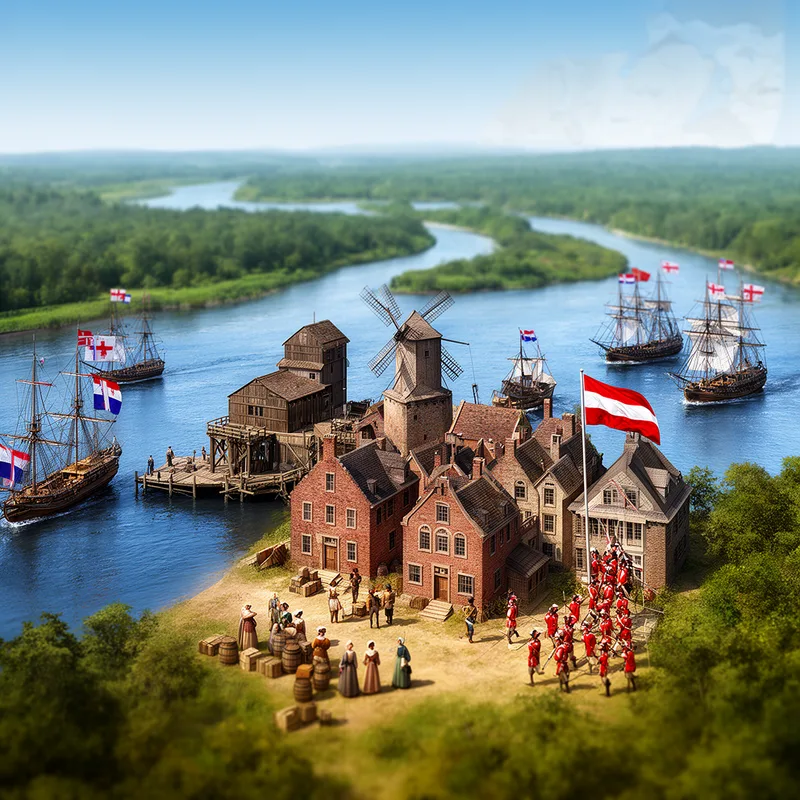
In 1621, the Dutch government gave control of a 250-mile strip of the American continent, called New Netherland, to the Dutch West India Company.
Surface Forms
Morphology
New + Netherland
The phrase is transparently composed of 'New' + 'Netherland', so a learner who knows the words can infer it names a place related to the Netherlands (the 'new' version of that place), and the 'New + place' naming pattern is cross-linguistically common. However, the precise historical sense (a former Dutch colony in North America, annexed in 1664) and its status as a specific historical proper noun are not derivable from the constituents alone, so the transparency is only partial.
Etymology
New Netherland was the name Dutch settlers gave to their new home in North America, named after the Netherlands back in Europe. The word Nether means 'low land', so the name made people think of a 'new low country' by the Hudson, and that is why it became the name of the Dutch colony that later became New York.