
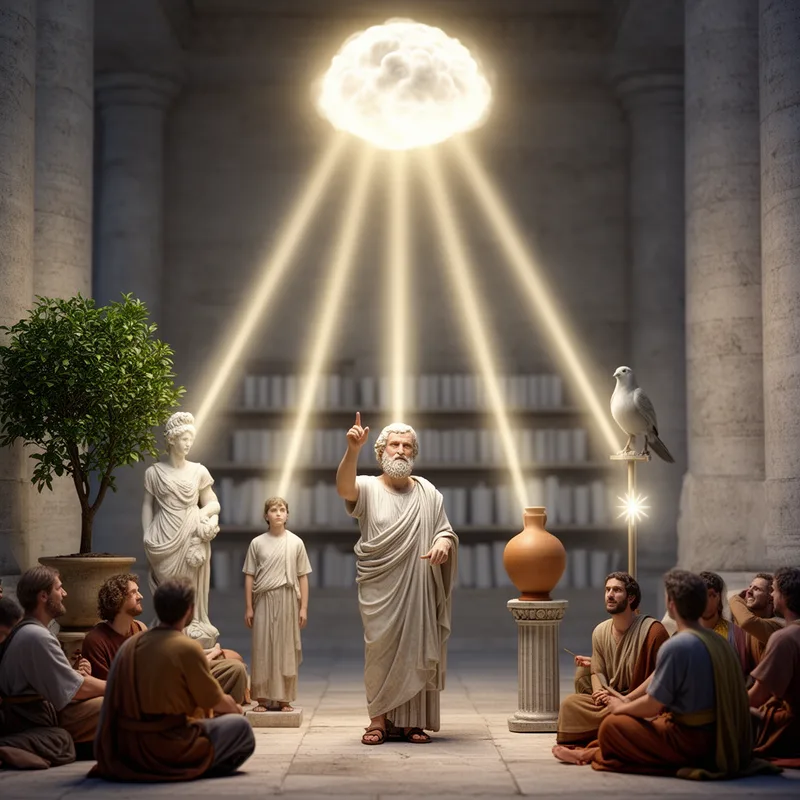
Neoplatonic


 1
9.9
- adjective
- /ˌniːoʊˈpleɪtɒnɪk/
- Specialized
- Many Renaissance artists were influenced by Neoplatonic ideas about beauty and love.
- Neoplatonic love
- Neoplatonic theory
- Neoplatonic concept
Loading YouTube…
Watch on YouTubeThis is obviously in the Platonic and the whole Neoplatonic tradition, this idea of participation that.
- This is obviously in the Platonic and the whole Neoplatonic tradition, this idea of participation that.
Examples
-
Underlying this difference are two disparate philosophical impulses that have their roots in the Neoplatonic effort to account for beauty by combining elements of Platonic mysticism and Aristotelian and Stoic empiricism.
Academic text (2007) -
The Byzantine sacred portrait can be seen to function in Neoplatonic terms.
Academic text (2006) -
So it's tied in with Neoplatonic thought as well.
-
So the union at the end is not just a Neoplatonic union of Renaissance ideas is union through love.
-
Botticelli clearly showed the influence... of the Neoplatonic cult.
-
Moreover, it is argued in Neoplatonic terms that are a common language for Christianity, Islam, and Judaism.
Academic text (1999) -
Yet the inclusion of this scene in the School of Athens also points to a rather daring aspect of Neoplatonic thinking:
Academic text (1995) -
One should also remember that Apollo and Apollo Helios were favorite Neoplatonic symbols of Christ.
Academic text (1995) -
Because of the Neoplatonic concept behind the syntagm, the transformed signs now have a different referent.
Academic text (1995) -
As much as Origen may have been sympathetic to and influenced by Neoplatonic and Stoic cosmologies, his theology is rooted in Scripture.
Academic text (1993)
Synonyms
 6
8.7
Relates to Plato's idea that perfect forms are more real than the visible world
 1
9.7
About Plato's belief that perfect, unchanging forms exist beyond things we can touch

Relating to the ideas of Plotinus
Surface Forms
Morphology
Etymology
The word Neoplatonic comes from the prefix neo- meaning 'new' and Platonic from the philosopher Plato, so it describes a 'new' form of Plato's ideas, often about spiritual reality and unity.