
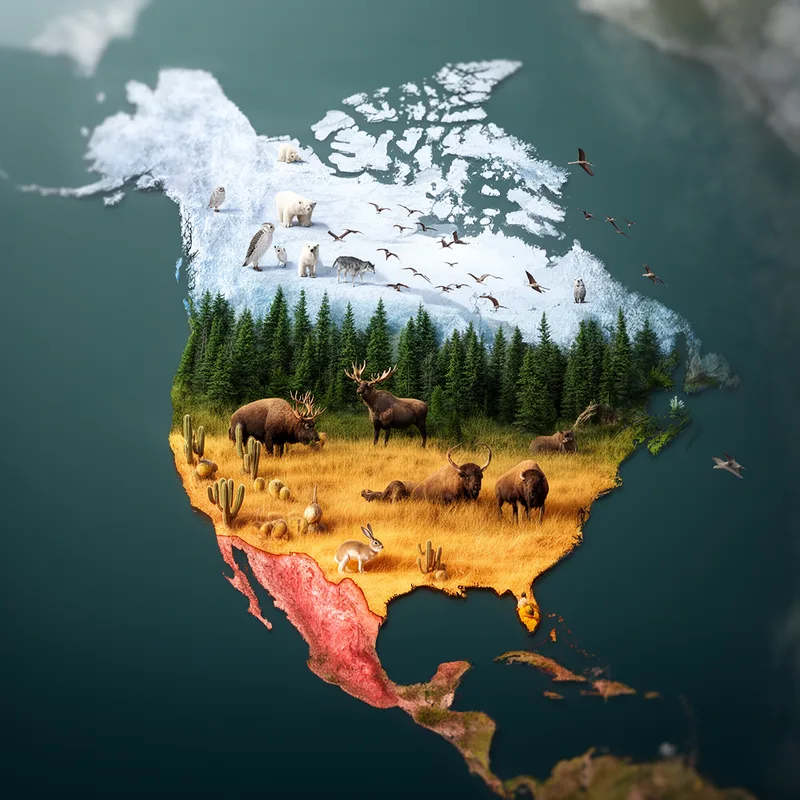
Nearctic
- noun
- /ˈnɪrktɪk/
- Specialized
- Zwolfer (1988) discovered that Nearctic thistles have a much smaller and less diverse insect fauna than European thistles.
- Nearctic-Neotropical migrant
- Nearctic-Neotropical
Examples
-
Hawkins (1990) made a more general survey assessing numbers of parasitoid species per host insect species in six different herbivore guild classes in the Nearctic and in the north Palearctic (largely Britain).
Academic text (1996) -
Nearctic ecoregions are adapted from the ecoregion systems of Omernik (1995), Gallant et al. (1995), Wiken et al. (1989), and Rzedowski (1978).
Academic text (2001) -
Rappole has noted that during winter, most of the Nearctic-Neotropical migrant species move into established bird communities.
Academic text (2010) -
It includes over 2,500 species of Nearctic Chalcidoidea wasps that belong to 20 different families.
Academic text (1995) -
Lion Heart's great-grandsire Storm Bird was bred by Taylor, as were that horse's sire and grandsire, Northern Dancer and Nearctic.
Blog text (7) -
One Nearctic-Neotropical migrant that uses Delaware as a stopover is a type of sandpiper known as the red knot.
Academic text (2010) -
The cerulean warbler is an example of a highly threatened Nearctic-Neotropical migrant whose summer breeding grounds have been known to include Delaware.
Academic text (2010) -
The Nearctic region is home to diverse wildlife, including species such as the bald eagle and the American bison.
-
Many birds migrate from the Nearctic each winter to warmer climates in the Neotropical region.
-
The flora in the Nearctic is distinct, featuring coniferous forests and a variety of temperate plants.
Surface Forms
Morphology
Etymology
Nearctic comes from the parts near ('close') and Arctic ('the cold north'). So as a noun it names the region of North America that lies near the Arctic and shares its typical plants and animals.

