
Myrciaria cauliflora
- noun
- Specialized
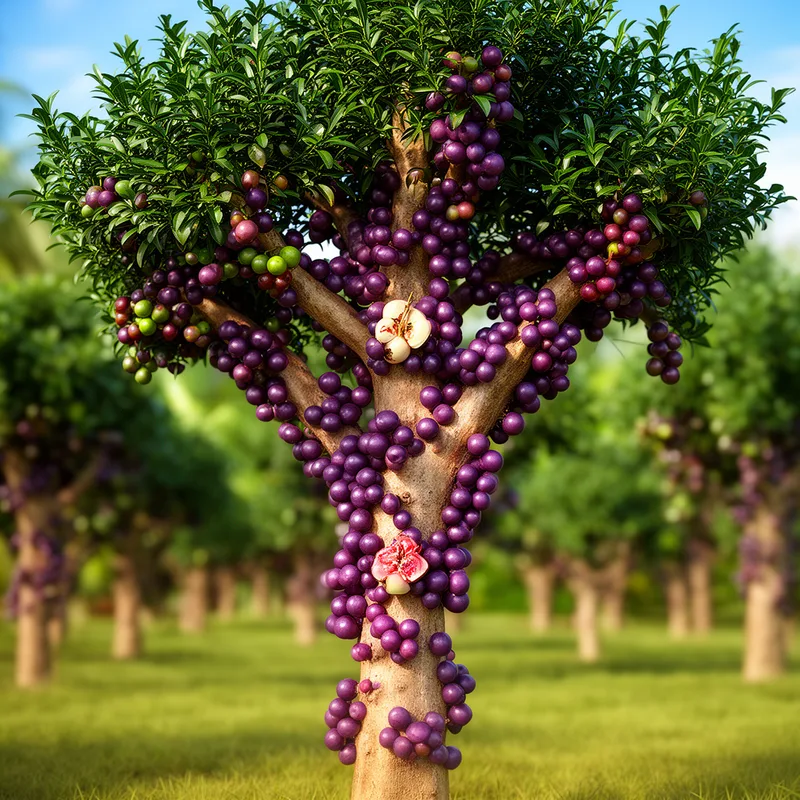
- The Myrciaria cauliflora is prized in Brazil for the sweet fruit that grows directly on its trunk and branches.
Examples
-
Unlike most trees, the fruit of Myrciaria cauliflora appears all along its woody stems rather than at the tips.
-
Many people enjoy the flavor of Myrciaria cauliflora fruits, which are similar to grapes and have tough skin.
-
Farmers in Florida have started cultivating Myrciaria cauliflora to supply the growing demand for exotic fruits.
-
The Myrciaria cauliflora tree thrives in tropical climates.
-
Have you ever tasted Myrciaria cauliflora fruits?
-
In Brazil, the Myrciaria cauliflora tree produces delicious fruits that grow directly from its branches.
-
The Myrciaria cauliflora is often found in tropical gardens alongside other exotic fruit trees.
Synonyms
A small tree from Brazil that has purple, grape-like fruit growing on its branches

A small evergreen tree from Brazil with purple grape-like fruit growing on its trunk and branches
Surface Forms
Morphology
Myrciaria + cauliflora
This is a Latin binomial (genus + species) and its parts are technical/Latinized terms rather than ordinary English words; 'cauliflora' is not a transparent English morpheme for a B1 learner. The overall meaning (a particular tropical tree with fruit growing on branches) cannot be derived from the constituent forms by an average B1 learner, so the expression is language-specific and opaque.
Etymology
Myrciaria cauliflora may come from Latin parts cauli meaning 'stem' and flora meaning 'flower', because the plant's flowers and fruit appear right on the trunk and branches. That's why the name points to the tree's unusual habit of having fruit grow on its stems.

