
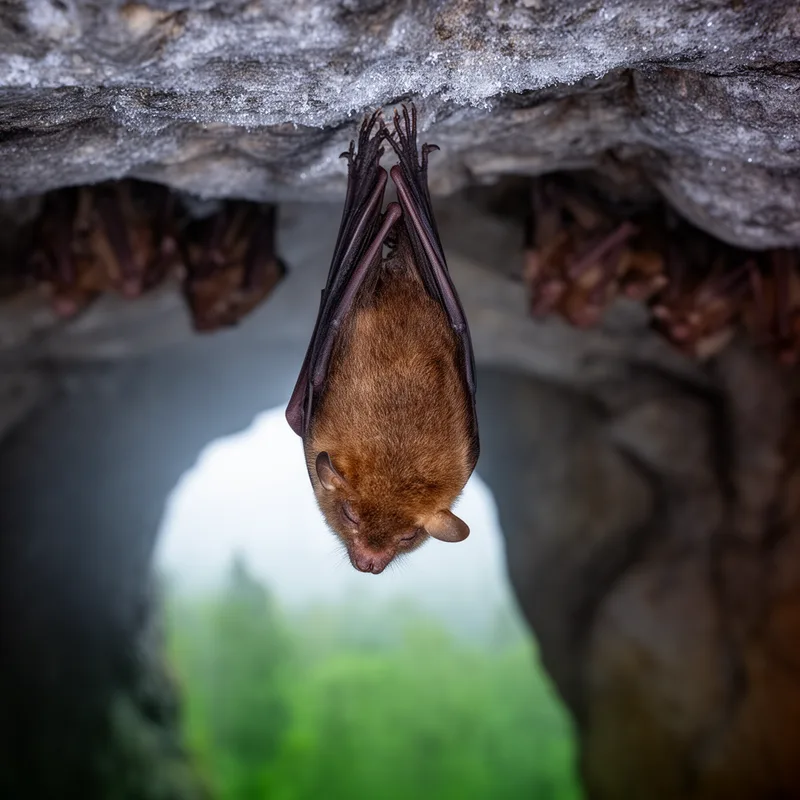
Myotis leucifugus
- noun
- /maɪˈoʊtɪs luˈsɪfədʒəs/
- Specialized
- The Myotis leucifugus is one of the most widespread bat species in North America.
Examples
-
White-nose syndrome has significantly impacted Myotis leucifugus populations in recent years.
-
Researchers studied the hibernation habits of Myotis leucifugus in northern caves.
-
The Myotis leucifugus is often found in caves.
-
Many researchers study the Myotis leucifugus for its behavior.
-
The Myotis leucifugus is commonly roosting in attics and old buildings across North America.
-
Conservation efforts are underway to protect the Myotis leucifugus from habitat loss.
-
In summer, the Myotis leucifugus can be seen flying around lakes and rivers at dusk.
Synonyms

A small common North American bat that lives across the continent

A small brown flying animal common in North America that sleeps in houses and forests
Surface Forms
Morphology
Myotis + leucifugus
This is a Latin binomial taxonomic name rather than a compositional English phrase: 'Myotis' labels a bat genus and 'leucifugus' is a non‑English species epithet (unknown in the dictionary), so a B1 learner knowing the parts would not be able to derive the everyday meaning 'little brown bat'. Scientific names function as conventional labels and their components are not transparently interpretable by general English learners, so the meaning must be learned by reference.
Etymology
Myotis leucifugus may come from old scientific words: Myotis means 'mouse-eared' because the bat is small with mouse-like ears, and leucifugus means 'white-fleeing' or 'avoiding light'. So the name paints a clear picture of a small, mouse-like bat that stays away from light, which fits the 'little brown bat'.

