

Mustelus canis
- noun
- Specialized
- The Mustelus canis is commonly known as the smooth dogfish.
Examples
-
Scientists spotted a group of Mustelus canis swimming close to the shoreline.
-
Commercial fisheries sometimes catch Mustelus canis accidentally in their nets.
-
The Mustelus canis is frequently studied for its unique digestive system.
-
Have you ever seen a Mustelus canis in the wild?
-
Commercial fisheries sometimes catch Mustelus canis accidentally in their nets.
-
Scientists spotted a group of Mustelus canis swimming close to the shoreline.
-
The Mustelus canis is frequently studied for its unique digestive system.
Synonyms

A small shark that lives on the sea bottom along the Atlantic coasts of North and South America
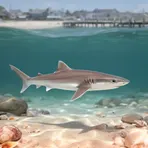
A small shark that lives along the Atlantic coast of the Americas with smooth skin and a thin body
Surface Forms
Morphology
This is a Latin binomial: knowing 'Mustelus' (a genus of smooth dogfish sharks) allows a learner to infer the phrase names a species within that shark genus, so they could reasonably guess it refers to a kind of shark. However, the second element 'Canis' (a mammal genus meaning 'dog') is not a transparent English modifier and taxonomic/Linnaean naming conventions and Latin knowledge are needed to interpret the epithet, so the overall composition is only partially predictable.
Etymology
The name Mustelus canis may come from Latin because canis means 'dog', and fishermen often called small sharks that nibble and follow boats 'dogfish'. So the scientific name links to the image of a small, dog-like shark, which is why it names this particular shark type today.

