

Musa textilis
- noun
- Specialized
- The fiber extracted from Musa textilis plants is commonly referred to as Manila hemp.
Examples
-
Ropes made from Musa textilis are valued for their resistance to saltwater.
-
Many farmers in the Philippines cultivate Musa textilis for its strong, durable fibers.
-
The Musa textilis plant is vital for the local economy.
-
Farmers grow Musa textilis for its valuable fibers.
-
Many farmers in the Philippines cultivate Musa textilis for its strong, durable fibers.
-
Ropes made from Musa textilis are valued for their resistance to saltwater.
-
The fiber extracted from Musa textilis plants is commonly referred to as Manila hemp.
Synonyms
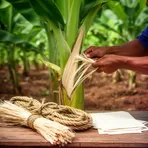
A Philippine banana plant whose leaf stalks give fiber for ropes and paper

A tall plant from the Philippines whose leaf stalks give strong fiber for rope, paper, and textiles
Surface Forms
Morphology
Musa + textilis
The first element 'Musa' clearly signals the banana/plant genus and the second element 'textilis' is transparently related to 'textile'/'woven', so a learner who knows both parts could infer this is a Musa used for fiber/textiles. However, species binomials are technical Latin labels and the precise meaning (Manila hemp, use for rope and paper) is specialized and not fully predictable for a B1 learner, so the transparency is partial.
Etymology
Musa textilis is the scientific name for a Philippine banana whose thick stems give a strong fiber called 'Manila hemp'. The part Musa is the banana and textilis points to 'cloth', so the name helps you remember that this plant makes strong material for 'rope' and 'paper'.

