

Mucor
- noun
- /ˈmjuːkɔr/
- Specialized
- The specific fungi that are encountered in most cases of rhinocerebral mucormycoses belong to the genera Rhizopus, Absidia, Mucor, or Rhizomucor.
Loading YouTube…
Watch on YouTubeOne way they save to to help it is to get a good implantation of Geotricum on that type of cheese and that can help inhibit Mucor.
- One way they save to to help it is to get a good implantation of Geotricum on that type of cheese and that can help inhibit Mucor.
Examples
-
Most pathogenic species are members of the family Mucoraceae, which includes the genera Absidia, Mucor, Rhizomucor, and Rhizopus.
Academic text (2004) -
Mucormycosis is caused by fungi of the orders Mucorales and Entomophthorales; among the genera are Absidia, Mucor, and Rhizopus.
Academic text (2006) -
The lactophenol cotton blue mount from the growth revealed Mucor spp.
Academic text (2006) -
The culture dish showed rapid growth of Mucor, indicating favorable conditions for this mold.
-
We identified Mucor as the contaminating organism in the experiment due to its unique sporangial structure.
-
Researchers observed that Mucor spp. thrive in damp environments, characteristic of many molds.
Synonyms


 1
9.9
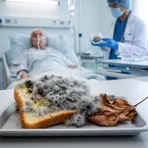
A type of mold that grows on dead plants or food and can infect people with weak immune systems
Surface Forms
Etymology
Mucor comes from the Latin word mucus, meaning 'slime' or 'mucus'. So the name fits a group of molds that often make slimy growths on food and in nature.