
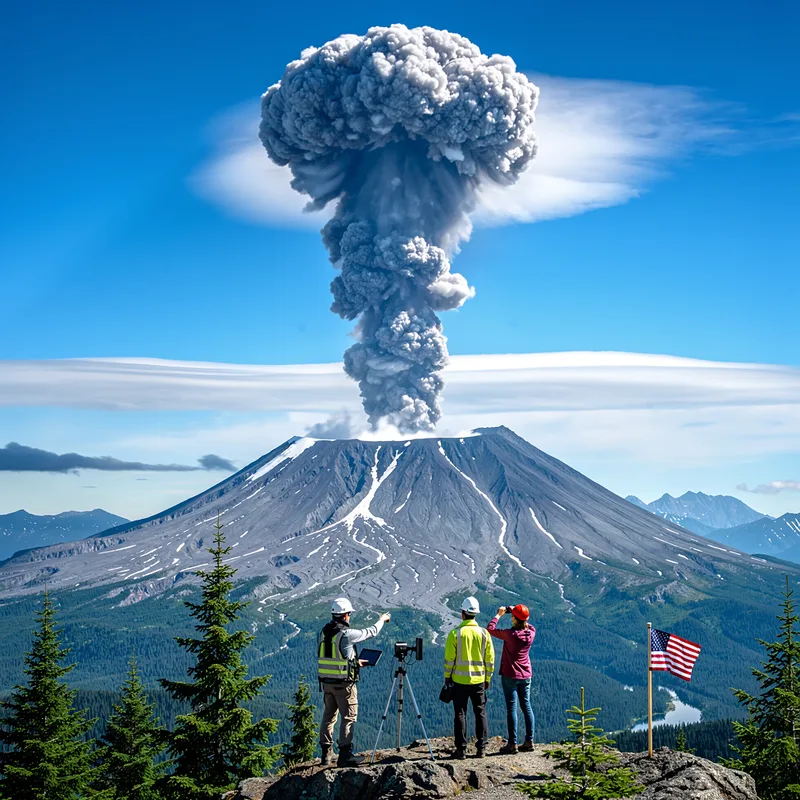
Mount St. Helens
 3
4.9
3
4.9

- proper noun
- /maʊnt seɪnt ˈhɛlənz/
- Many tourists visit Mount St. Helens each year to learn about its geological history and the impact of its eruptions.
- Mount St. Helens eruption
- 1980 eruption of Mount St. Helens
- blast at Mount St. Helens
Examples
-
Today's top story, Mount St. Helens.
-
Mount St. Helens is an active volcano in southwest Washington State and the central feature of the Mount St. Helens National Volcanic Monument. Mount St. Helens is a popular climb for both beginning and experienced mountaineers.
Blog text (20) -
Mount St. Helens is an active volcano in southwest Washington State and the central feature of the Mount St. Helens National Volcanic Monument. Mount St. Helens is a popular climb for both beginning and experienced mountaineers.
Blog text (20) -
The 1980 eruption of Mount St. Helens dramatically changed the landscape of the surrounding area.
-
Scientists closely monitor seismic activity at Mount St. Helens to predict future eruptions.
Synonyms

An active volcano in western Washington known for its 1980 eruption
A volcano in Washington State known for its large 1980 eruption
Surface Forms
Morphology
mount + St. + Helens
The headword 'Mount' clearly denotes a mountain and 'St. Helens' functions as a place/name, so a learner who knows 'mount' and recognizes 'St.' as part of a place name will infer this is a specific mountain. This compositional pattern (mount + proper name) is cross-linguistically common, so the basic meaning (a mountain/place) is transparent even if specific facts about the volcano are not derivable from the constituents.
Etymology
Mount St. Helens was named by a British explorer to honor a diplomat called 'St Helens'. Today Mount St. Helens is the active volcano that famously had a huge 1980 eruption that blew off part of its top, and that strong image helps you remember the name.