
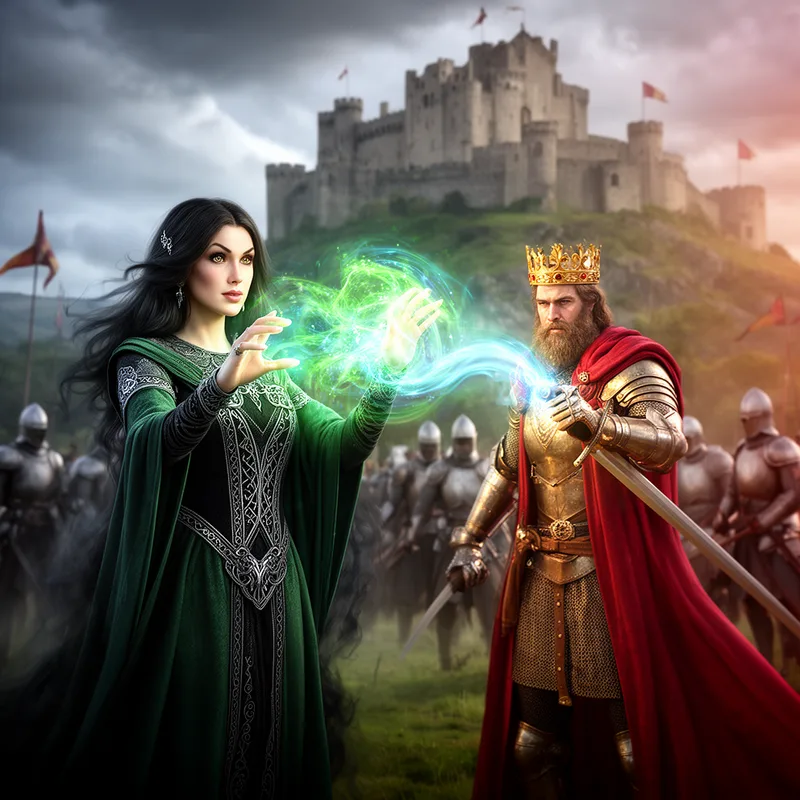
Morgan le Fay
- proper noun
- /ˈmɔrɡən lə feɪ/
- Literature
- In many tales, Morgan le Fay is depicted as a formidable sorceress.
Examples
-
Scholars continue to debate whether Morgan le Fay was truly wicked or simply misunderstood.
-
Many tales depict Morgan le Fay using her magic to oppose King Arthur and his knights.
-
The mysterious character of Morgan le Fay appears in several adaptations of Arthurian legend.
-
Morgan le Fay is powerful.
-
In Arthurian legend, Morgan le Fay is often portrayed as a powerful enchantress who challenges King Arthur.
-
Morgan le Fay is depicted as both an ally and adversary of King Arthur in many stories of Arthurian legend.
-
The tales of Morgan le Fay reveal her complex character as a half-sister to King Arthur and a formidable magician.
Synonyms

 5
9.9
5
9.9

A woman with magical powers in Arthurian legend sometimes shown as King Arthur's half-sister
Surface Forms
Morphology
Morgan + le + fay
This is a proper name from Arthurian legend whose specific identity and role (a powerful enchantress, Arthur's half-sister and sometimes adversary) cannot be deduced from its parts. The constituents include a personal name and archaic/foreign elements ('le' as a French article, 'fay' meaning fairy), so even if a learner recognised 'fay' as related to 'fairy' they would not infer the cultural and relational details required to understand the MWE.
Etymology
Morgan le Fay may come from an old way of saying Morgan plus le Fay, where le Fay means 'the fairy'. One popular story says people called her a 'fairy' because she used magic in the tales, so the name helps explain why she is a powerful enchantress in Arthurian stories.