
Monothelitism


 1
9.9
- noun
- /ˌmɒnəˈθɛlɪˌtɪzəm/
- Formal
- As Rahner observed, monothelitism is never far removed from monophysitism, and monophysitism is never far removed from a Christology where humanity assumes a merely passive role in the work of salvation.
- the problem of monothelitism
Examples
-
(n57) Thomas' solution stands then as an alternative to the heresies that gave rise to monothelitism.
Academic text (1991) -
Heris adds that the problem raised by monothelitism was not so much the existence of two wills in Christ as it was the matter of their union and relations.
Academic text (1991) -
The history of monothelitism colors the background of Q. 19, A. 1.
Academic text (1991) -
Thus, I shall begin by situating ST 3, q. 19, a. 1 in relation to the historical problem of monothelitism which it presupposes.
Academic text (1991) -
The body of ST 3, q. 19, a. 1 indicates that this article is in fact concerned with the consequences of the union of the two natures in light of the issues raised by monothelitism.
Academic text (1991) -
THE PROBLEM OF MONOTHELITISM
Academic text (1991) -
In general, it can be said that monothelitism consisted in a refusal to speak of two distinctly functioning and complete wills or operations corresponding to the two complete and distinct natures of the hypostatic union.
Academic text (1991) -
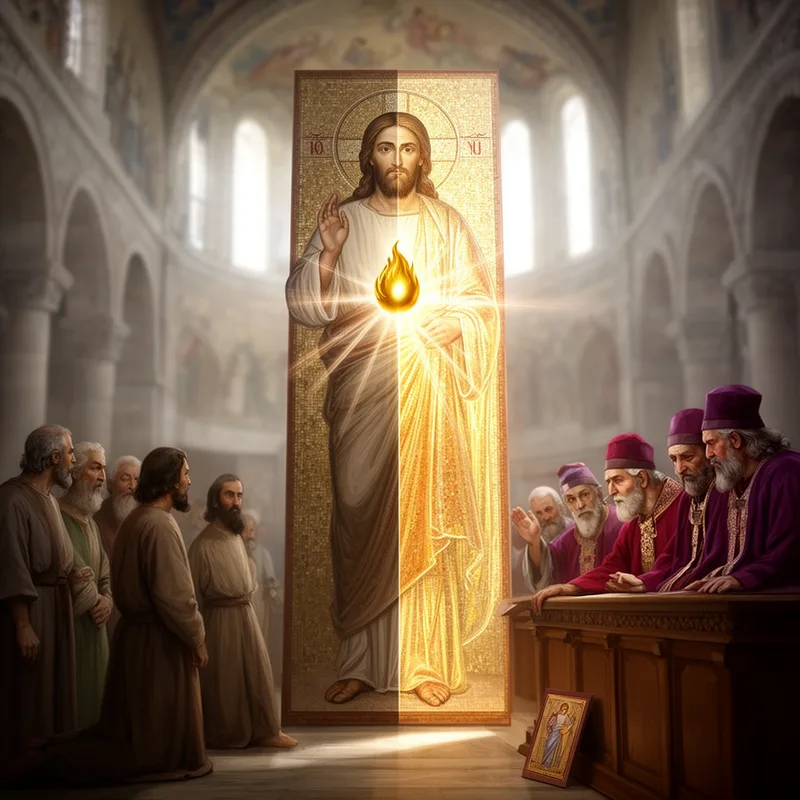
The doctrine of Monothelitism suggests that Christ had only a single will despite His dual natures.
-
Historians debate Monothelitism as a significant theological issue in early Christianity.
-
Many theologians argue that Monothelitism conflicts with the belief in the full humanity and divinity of Christ.
Surface Forms
Morphology
Monothelitism = monothelite (opaque) = mono + thel + ite + ism
The base 'monothelite' is itself a specialized theological term, so adding '-ism' does not make the doctrine transparently understandable to most learners.
Etymology
The word Monothelitism comes from Greek parts mono- meaning 'one', thelema meaning 'will', and the ending -ism meaning 'belief'. So Monothelitism literally means 'one-will belief' and is used for the belief that Christ had only one will even though he had two natures.