
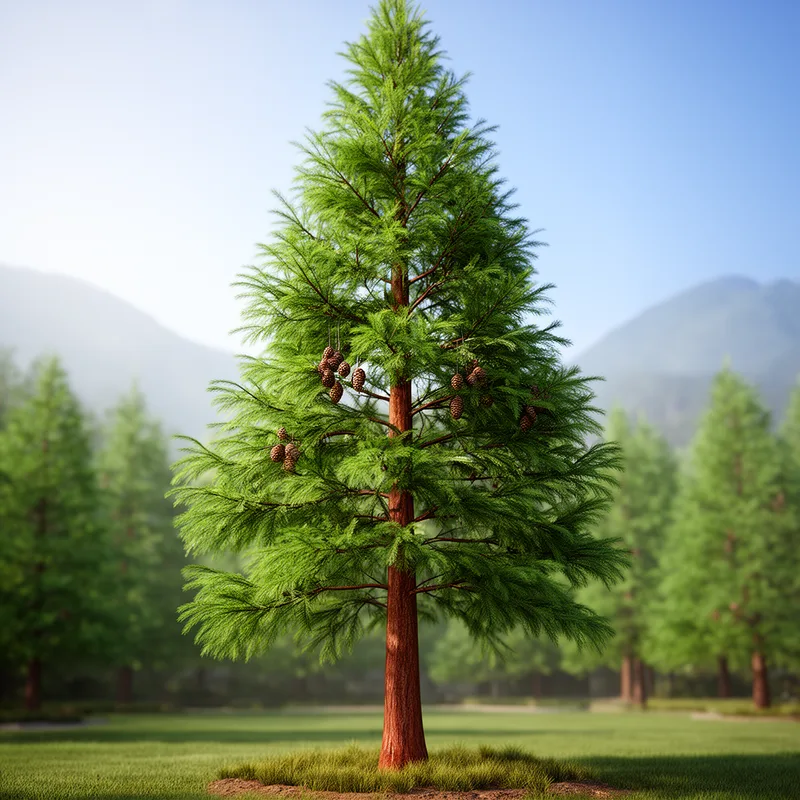
Metasequoia glyptostroboides
- noun
- /ˌmɛtəˌsɛkwoʊɪə ɡlɪptoʊˈstroʊboʊɪdz/
- Specialized
- The Metasequoia glyptostroboides is prized by landscapers for its rapid growth and elegant appearance.
Examples
-
Botanists were amazed when living specimens of Metasequoia glyptostroboides were discovered in China in the 1940s.
-
Many arboretums in the United States now feature Metasequoia glyptostroboides as a centerpiece tree.
-
The Metasequoia glyptostroboides is often referred to as the dawn redwood.
-
Many gardeners love the Metasequoia glyptostroboides for its unique appearance.
-
Many arboretums in the United States now feature Metasequoia glyptostroboides as a centerpiece tree.
-
Botanists were amazed when living specimens of Metasequoia glyptostroboides were discovered in China in the 1940s.
-
The Metasequoia glyptostroboides is prized by landscapers for its rapid growth and elegant appearance.
Synonyms

A tall tree from China that grows fast and has flat green leaves and small round cones

A large Chinese tree that loses its leaves in autumn and is often grown in parks
Surface Forms
Morphology
metasequoia + glyptostroboides
This is a scientific Latin binomial: the first element ('metasequoia') signals a type of tree, so a learner who knows that constituent could infer it names a tree species, but the second element ('glyptostroboides') is technical/opaque and provides no clear additional meaning. Because the name is low-frequency, domain-specific, and functions as a proper taxon rather than a compositional English phrase, its overall meaning is only partly recoverable from the parts.
Etymology
Metasequoia glyptostroboides got its name after living trees were found in China in the 1940s when people thought it only existed as fossils. The name parts help the memory: Metasequoia means 'like Sequoia' and glyptostroboides means 'like Glyptostrobus', so the long scientific name paints a picture of a living ancient redwood, the 'dawn redwood' we know today.

