

Mephistopheles
 8
9.9
8
9.9

- proper noun
- /ˌmɛfɪˈstɑfəlɪz/
- Literature
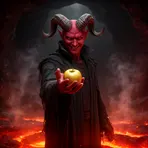
- In the story, Faust makes a pact with Mephistopheles, giving up his soul for knowledge and pleasure.
Examples
-
The cunning Mephistopheles appeared before Faust to tempt him with forbidden desires.
-
Throughout the play, Mephistopheles symbolizes the struggle between good and evil in human nature.
-
Keep Mephistopheles from getting his hands on it.
-
Now I had found my Mephistopheles.
Academic text (2005) -
Then the play began: the pact of Faust and Mephistopheles.
Fiction book (1993) -
As we will see, Adorno himself appears in the novel partly in the form of Mephistopheles.
Academic text (2000) -
But Mephistopheles is undeterred: "I'll fetch thee fire to dissolve it straight.
Academic text (2012) -
In Act 1, Scene 5, to cement his bargain with Lucifer, Faustus is told by Mephistopheles to "write a deed of gift with thine own blood."
Academic text (2012) -
Goethe, a wise European, ingeniously summed it up in the character of Mephistopheles: "I am the spirit that always negates" (Faust I, line 1338, my translation).
Academic text (2003) -
Dostoevsky must have remembered the famous line that Goethe put into the mouth of Mephistopheles: "I am the spirit that always says no" ("Ich bin der Geist der stets verneint").
Academic text (1995)
Synonyms
 318
5.3
318
5.3
A powerful spirit that represents evil and tempts people
 106
5.1
106
5.1
A cruel person who causes great harm to others
Surface Forms
Etymology
Mephistopheles is easy to remember if you think of it as a mix of mephisto (a part some people link to 'destroyer') and the Greek philos ('friend' or 'lover'). So the name sounds like a 'friend who destroys', which fits a demon who tempts people into harm.