
Melanesia


 1
7.1
- proper noun
- /ˌmɛləˈniːʒə/
- Big man stature, in different parts of Melanesia, depends on an assortment of achieved or inherited resources and talents (Lindstrom 1981a).
- eastern Melanesia
- Melanesia and Polynesia
- people in Melanesia
Examples
-
The Solomon Islands lie in Melanesia, some 2,000 miles west of Tutuila.
Academic text (2005) -
Clearly, a great opportunity for recording oral tradition now presents itself to a recently educated literate people in Melanesia.
Academic text (1990) -
"Big Women" have rarely been described in Melanesia.
Academic text (1990) -
The direction and management of social and ritual life is not a constant in Melanesia.
Academic text (1990) -
In Melanesia, aid to remote communities should not be contingent upon their claims to historical isolation.
Academic text (1997) -
The studies of Melanesia today shed new light on the processes that produce leadership, heroism, and legend-making.
Academic text (1990) -
Douglas (1979), taking a general look at eastern Melanesia, finds an overlap of ascribed and achieved status.
Academic text (1990) -
Chris Ballard, of ANU's Pacific and Asian History Division, concluded in his studies of rock art in western Melanesia that the Timorese paintings fit into a broad "Austronesian painting tradition" that shares specific techniques, colors, and motifs.
Academic text (2003) -
Sahlins's (1963) masterful formulation has proved a fruitful stimulant to discussions of leadership, power, and renown in Melanesia and Polynesia.
Academic text (1990) -
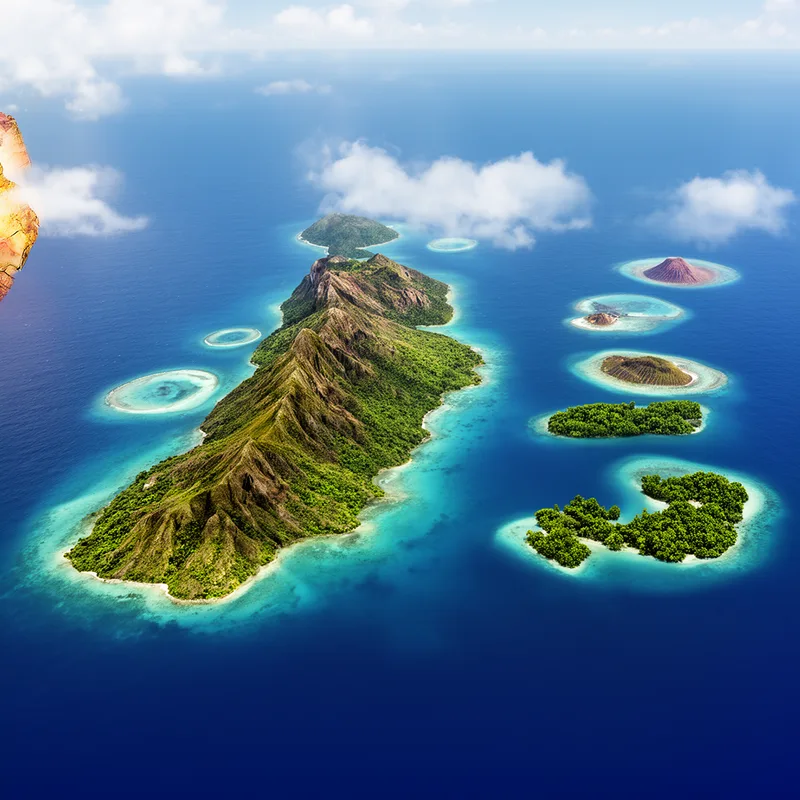
The islands of Melanesia are known for their rich cultural diversity and stunning landscapes.
Surface Forms
Etymology
Melanesia comes from Greek parts melan- meaning 'dark' and -nesia meaning 'islands', the same -nesia you see in Polynesia and Micronesia. So Melanesia became the name for a group of Pacific islands like New Guinea, Fiji, the Solomon Islands and Vanuatu, named by early visitors for the darker skin of many of its people.