
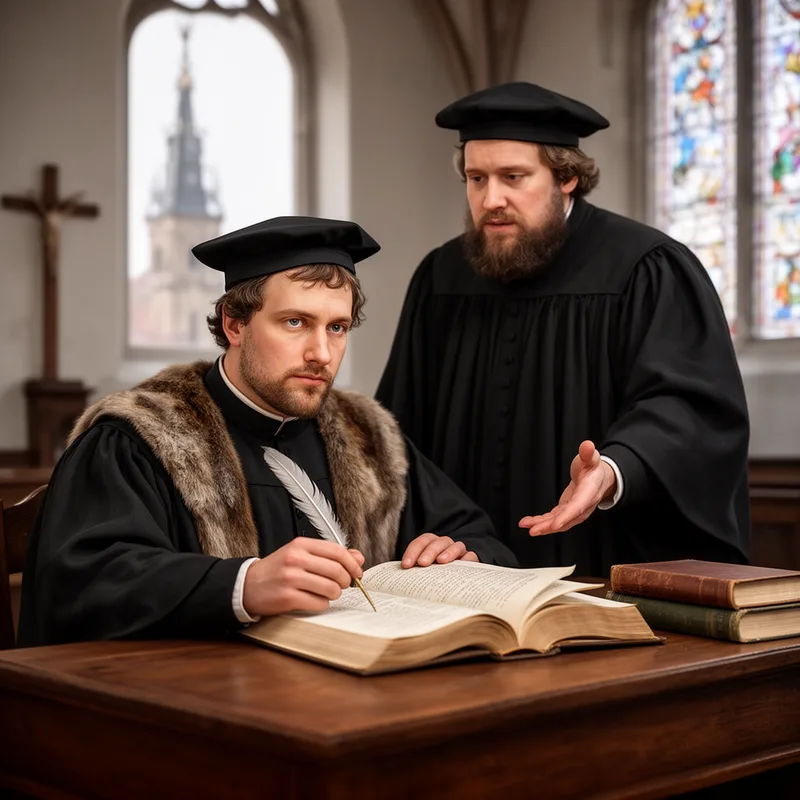
Melanchthon


 1
9.9
- proper noun
- /ˈmɛlənkθən/
- The guiding, teaching, and disciplining function is really palpable in the ethics of Luther, but he was not convinced by his colleague Melanchthon of the necessity for the third use of the law.
- Philip Melanchthon
Examples
-
The square is dominated by the historic city hall, in front of which are prominent bronze statues of Martin Luther and Philip Melanchthon, and it is framed by stylish, gabled Renaissance buildings that now house shops, offices, and restaurants.
Academic text (2002) -
Borrowing from Melanchthon, Sarcerius illustrated how to approach both simple and composite themes.
Academic text (2004) -
Melanchthon: They say that you've encouraged people to question authority and to think for themselves.
Fiction book (1998) -
Melanchthon: They say that the princes keep demanding more work and higher taxes and give nothing in return.
Fiction book (1998) -
What could have remained a Platonic ideal came to the ground in Melanchthon's writings just as it did in practice.
Academic text (2002) -
In the first edition of his popular textbook on rhetoric, Melanchthon was one of the first to give advice on how to write an evangelical sermon.
Academic text (2004) -
Proponents asserted that Luther and his colleague, Philip Melanchthon, actually preferred a church polity that featured great prominence for bishops who stood in apostolic succession.
Academic text (2002) -
What was consistently "necessary" from Luther's, Melanchthon's, and the Confessions' point of view was that the word be preached and the sacraments administered in accord with it.
Academic text (2002) -
Philipp Melanchthon was a key figure in the Protestant Reformation, shaping theological education and reform.
-
As a close associate of Martin Luther, Melanchthon played a significant role in the early development of Protestant beliefs.
Synonyms
 1
9.9
A German religious teacher and reformer who worked with Martin Luther
 1
9.9
A German religious scholar who worked with Martin Luther to shape the Protestant Reformation
Surface Forms
Etymology
Melanchthon comes from Greek parts melan- 'black' and -chthon 'earth'. It is a Greek translation of his German family name Schwarzerdt ('black earth') that he chose as a scholar, so the name points to his learned identity in the Reformation.