

Masticophis bilineatus
- noun
- Specialized
- The Masticophis bilineatus is recognized for its speed and agility in both terrestrial and arboreal habitats.
Examples
-
The diet of Masticophis bilineatus includes lizards, birds, and small mammals.
-
Researchers found a Masticophis bilineatus basking on a rocky ledge in Arizona.
-
The Masticophis bilineatus is often found in desert habitats.
-
Have you ever seen a Masticophis bilineatus in the wild?
-
Researchers found a Masticophis bilineatus basking on a rocky ledge in Arizona.
-
The Masticophis bilineatus is recognized for its speed and agility in both terrestrial and arboreal habitats.
-
The diet of Masticophis bilineatus includes lizards, birds, and small mammals.
Synonyms
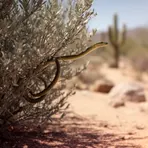
A slender fast-moving snake from deserts that climbs bushes and trees

A small fast snake with a long thin tail that moves like a whip

A small fast snake with a long thin body and tail

A small fast snake with a long thin tail
Surface Forms
Morphology
Masticophis + bilineatus
The construction is a biological binomial (genus + species), so knowing 'Masticophis' (a snake genus) lets a learner infer this refers to a particular type of snake; however, the specific epithet 'bilineatus' is Latin and not in the learner-facing dictionary entry, so its descriptive sense (e.g. 'two-lined') is not predictable to an average B1 learner. The name therefore partly transparently signals 'a species of Masticophis' but requires specialized or Latin-root knowledge to recover the full descriptive meaning.
Etymology
Masticophis bilineatus comes from two parts: Masticophis from old words meaning 'whip' and 'snake' and bilineatus from Latin meaning 'two-lined'. So the name gives a clear picture of a fast, whip-like snake with two light stripes, which matches the Sonoran whipsnake and helps you remember this species.

