
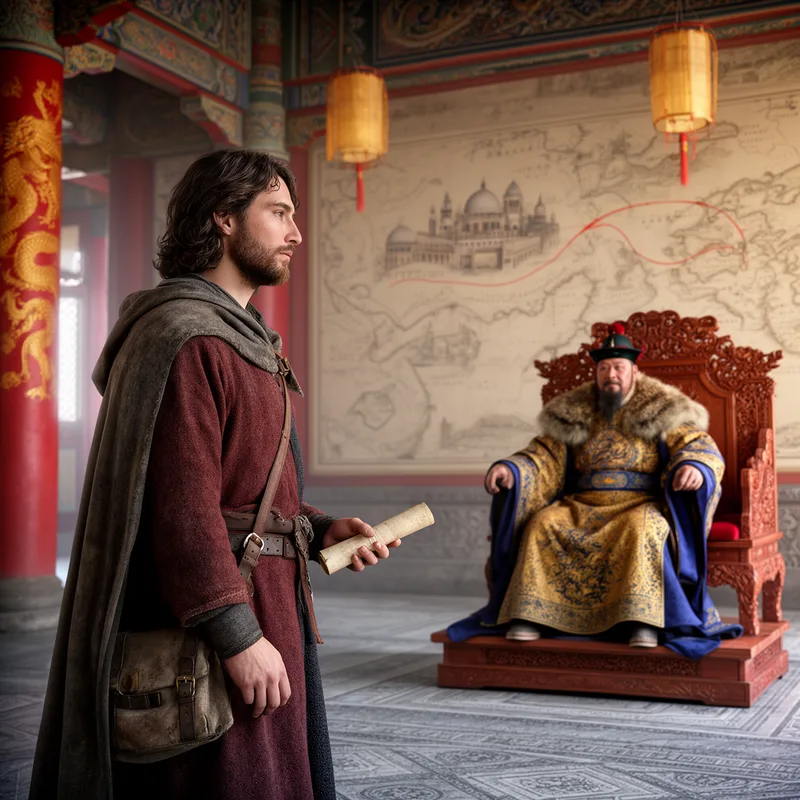
Marco Polo
 6
4.6

- proper noun
- In the late 13th century, Marco Polo traveled to China and documented his experiences in detail.
Examples
-
During his travels, Marco Polo served at the court of Kublai Khan, sharing stories of his adventures.
-
Korcula, Bill Montgomery's isle of fancy, may have been the birthplace of Marco Polo.
Academic text (2000) -
Pearl S. Buck, America's first woman Nobel Prize winner, who spent half of her life in China and was known as the most influential Westerner to write about China since Marco Polo, quickly emerged as one of the most tenacious wartime opponents of racial discrimination.
Academic text (2000) -
Marco Polo, the Venetian explorer, is famous for his extensive journeys along the Silk Road.
Surface Forms
Morphology
Marco + Polo
The string 'Marco Polo' is a frozen proper name denoting a specific historical person; its meaning (a 13th-century Venetian explorer) cannot be compositionally derived from the constituent names 'Marco' and 'Polo', which have no relevant lexical senses that point to exploration. Recognizing this MWE therefore depends on cultural or historical knowledge rather than knowledge of its parts, so a B1 learner who only knows the constituents would not be able to infer the meaning.
Etymology
Marco Polo was a real 13th-century man from Venice who traveled far into Asia and worked for the ruler Kublai Khan. He wrote exciting stories about the places he saw, so his name now makes people think of a famous 'traveler' or someone who explores distant lands.