
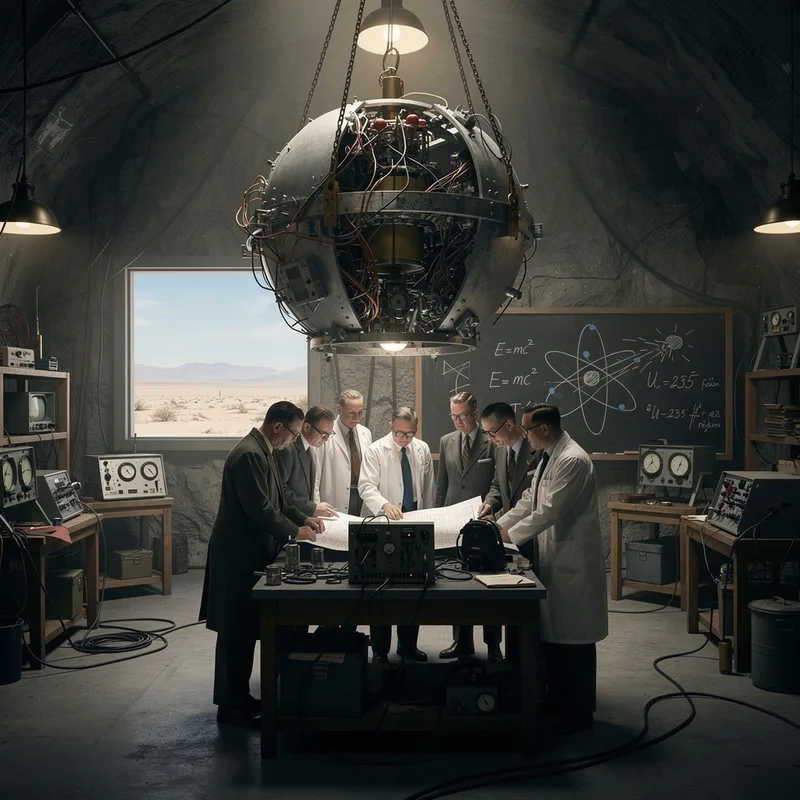
Manhattan Project
 10
4.2
10
4.2

- proper noun
- /mænˈhætən ˈprɒdʒɛkt/
- In 1941, he moved to Columbia University, where he stayed until he joined the Manhattan Project in 1942.
- worked on the Manhattan Project
- part of the Manhattan Project
- Manhattan Project at Los Alamos
Loading YouTube…
Watch on YouTubeBut the NKVD recruited people within every part of the Manhattan Project.
- But the NKVD recruited people within every part of the Manhattan Project.
- There were a lot of physicists leftover from the Manhattan Project who kind of liked living there.
- And there they're unlocking that simultaneously in these defense programs, right in the Manhattan Project.
Examples
-
The combined scientific and industrial program of unprecedented size and secrecy was code-named the Manhattan Project.
Academic text (2006) -
J. Robert Oppenheimer, a distinguished theoretical physicist, was the scientific director of the Manhattan Project.
Blog text (21) -
During World War II, he was a member of the Manhattan Project.
Academic text (2004) -
He worked on the Manhattan Project.
-
Before he finished writing his thesis, he left NYU to work on the Manhattan Project at Los Alamos.
Academic text (1995) -
What would become the Manhattan Project began in the late 1930s when Albert Einstein wrote a letter to Franklin Roosevelt.
Academic text (2005) -
The Manhattan Project has been plagued from the start by certain scientists of doubtful discretion and uncertain loyalty.
-
During World War II, the scientists involved in the Manhattan Project worked secretly to develop the first atomic bombs.
-
The Manhattan Project employed thousands of people across various locations to create the world's first nuclear weapons.
-
Los Alamos was the primary site for the Manhattan Project, where key developments in atomic bomb technology took place.
Surface Forms
Morphology
The intended meaning (a large-scale, high-priority, tightly coordinated initiative) cannot be derived from 'Manhattan' (a place) + 'project' (planned work); a B1 learner who knows the words would most likely assume it refers to a project located in Manhattan. The idiomatic/metaphorical use comes from a specific historical reference (the WWII atomic program) and requires cultural or prior exposure, so the expression is not transparently compositional.
Etymology
Manhattan Project gets its name from the Army office in Manhattan, New York, where the secret work was run during World War II. It was a large US effort that brought leading scientists together to make the first atomic bombs, so the name now refers to that wartime program 'to make the first atomic bombs'.