
Malus angustifolia
- noun
- Specialized
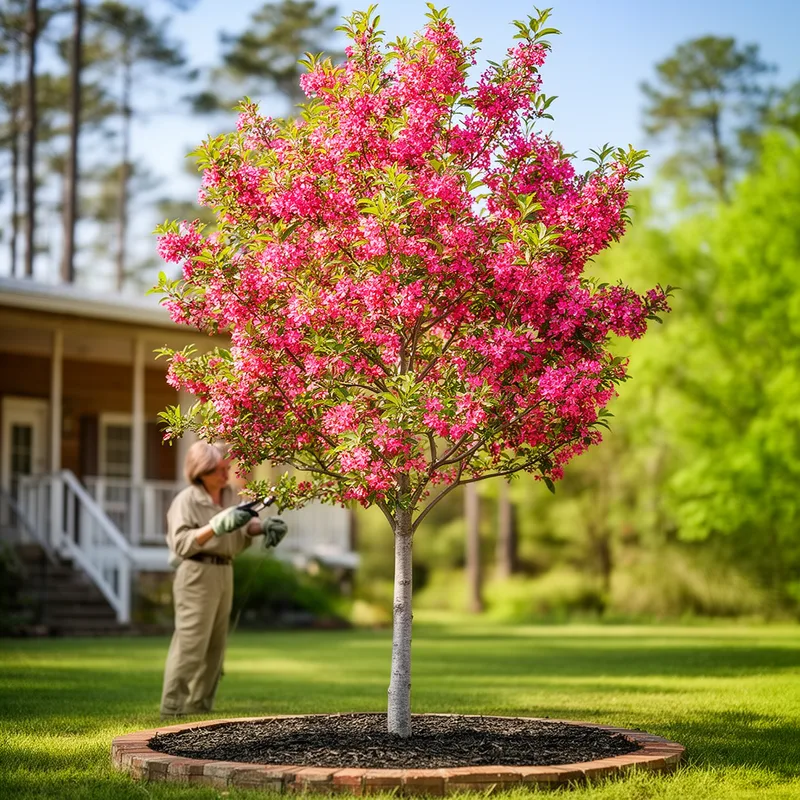
- The Malus angustifolia brightens southern gardens with its vibrant rose-colored blossoms each spring.
Examples
-
Wild Malus angustifolia can often be found at the edges of forests in Alabama.
-
Many gardeners in the southeastern U.S. cultivate Malus angustifolia as a decorative tree.
-
The Malus angustifolia blooms beautifully in spring.
-
In gardens, Malus angustifolia adds vibrant color.
-
Many gardeners in the southeastern U.S. cultivate Malus angustifolia for its beautiful, ornamental flowers.
-
The Malus angustifolia tree is a favorite among landscapers for its striking rose-colored blossoms.
-
In the springtime, the Malus angustifolia showcases its lovely pink flowers, attracting many pollinators.
Synonyms

A small tree or shrub from the southeastern United States grown for its pretty pink spring flowers
Surface Forms
Morphology
Malus + angustifolia
This is a botanical Latin binomial (genus + specific epithet). In principle the meaning is compositional — 'Malus' marks the apple/crabapple genus and 'angustifolia' (Latin for 'narrow‑leaved') specifies a trait — so a learner who knew the Latin epithet could infer the species meaning. However, 'angustifolia' is not an English word and B1 learners normally lack the necessary Latin morphological knowledge, so the name is not immediately predictable for typical learners.
Etymology
Malus angustifolia comes from Latin words: Malus means 'apple' and angustifolia means 'narrow leaves'. So the name helps you remember it is an apple-like small tree with narrow leaves, known as the 'southern crabapple'.

