
Malthusian
 3
9.9
3
9.9

- adjective
- /mælˈθuːziən/
- Formal
- Population is assumed to move according to the usual Malthusian dynamic with respect to food consumption.
- Malthusian theory
- Malthusian instability
- Neo-Malthusian
Loading YouTube…
Watch on YouTubeClark makes a big story about the Malthusian trap.
- Clark makes a big story about the Malthusian trap.
Examples
-
Then, we look at evidence in support of the assumption that food is bound by a Malthusian constraint.
Academic text (2018) -
Many economists warn that we could face a Malthusian crisis if agricultural production does not keep pace with population increase.
-
And we'll talk about that as a Malthusian limit in this particular.
-
And so my question for you is, you get this almost Malthusian problem of, you know, all these portraits and no space.
-
Are we stuck in a Malthusian predicament?
-
So this is the basic Malthusian dilemma.
-
The typical explanation is that humanity was stuck in a Malthusian trap.
Academic text (2018) -
In other words, the standard model would predict more food production until the Malthusian constraint is met.
Academic text (2018) -
With regard to a second issue, Malthusian theory predicts that economic prosperity and nutrition lead to increased fertility.
Academic text (1990) -
The green revolution beat back famine in Asia and Latin America, disproving the dire Malthusian predictions.
Academic text (2010)
Compounds

- Formal
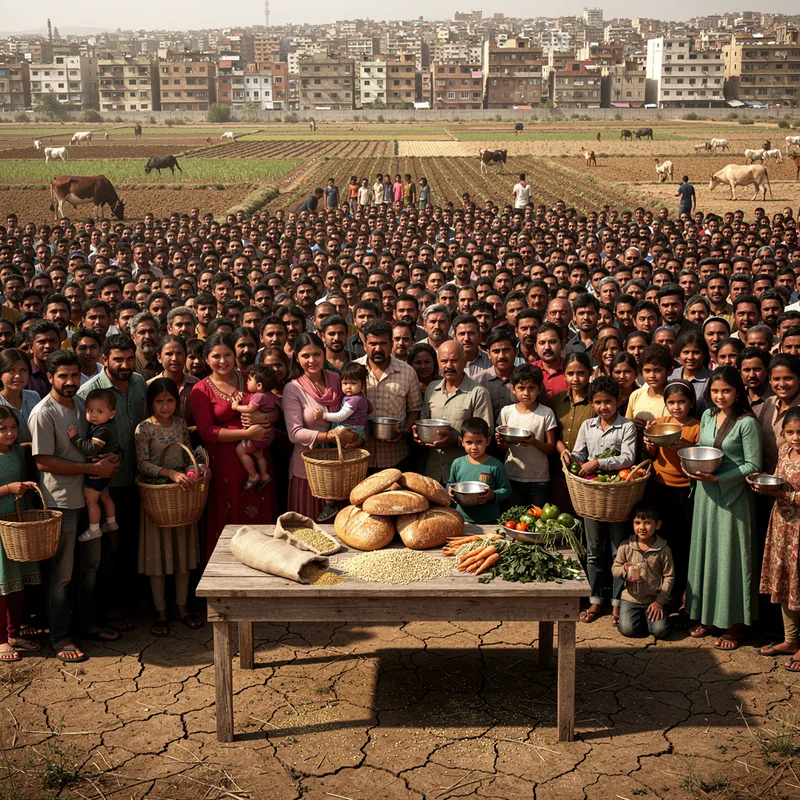
Population often grows faster than food and other resources, causing shortages
Surface Forms
Morphology
Malthusian = Malthus (semi-transparent) = Malthus + ian
Formed regularly from the name 'Malthus' + '-ian'; morphological relation is clear but the meaning requires knowledge of Thomas Malthus and his theories.
Etymology
Malthusian is an adjective that comes from the name of the economist Thomas Malthus, who warned that people can 'multiply' faster than food, causing shortages. The ending -ian is like in Newtonian and means 'relating to', so a Malthusian view warns that population can grow faster than the food supply.