
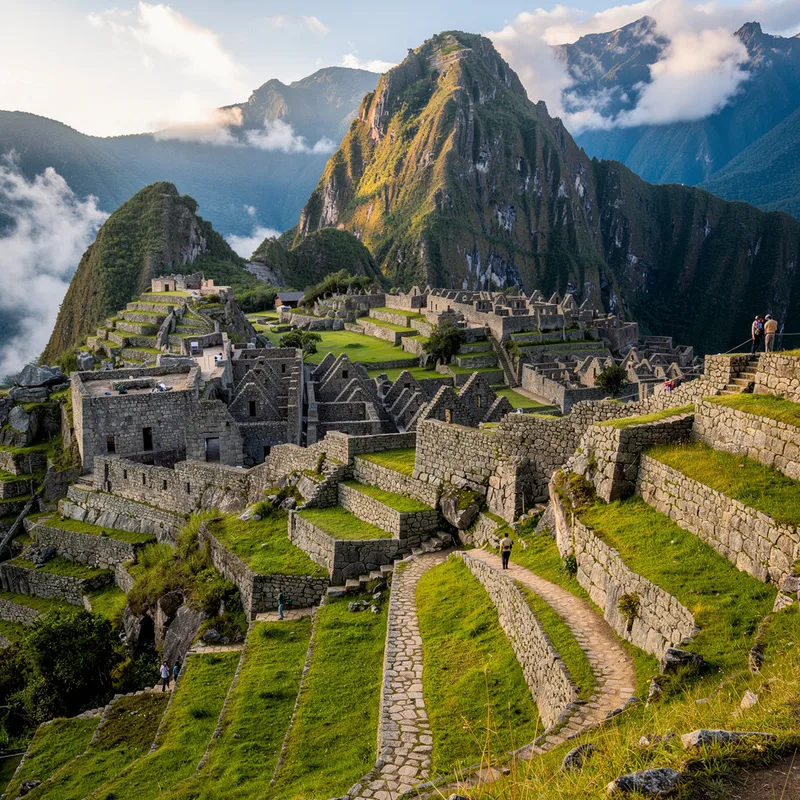
Machu Picchu
 13
6.3

- proper noun
- /ˈmɑːtʃu ˈpikʧu/
- But more significantly, Machu Picchu is linked to Andean notions of cosmology and sacred geography.
- heights of Machu Picchu
Loading YouTube…
Watch on YouTubeAnd now they think the same thing happened in Peru at places like Oyante Tambu, Machu Picchu, the Kori Kancha, things like that.
- And now they think the same thing happened in Peru at places like Oyante Tambu, Machu Picchu, the Kori Kancha, things like that.
- So there is the sun gate that as soon as you come across and you see the sun, then you're looking down on to Machu Picchu.
- But other places I've been and said, oh, I have to come back is Machu Picchu in Peru, and I've shot all up and down the Nile in each other.
- You know, what else is interesting is all of these wonders of the world, The pyramid, Stonehenge, Machu Picchu is a Easter Island.
Examples
-
Instead, get up early (crack of dawn) on day three and hike all the way to Machu Picchu.
Blog text (28) -
How many of you have been to Machu Picchu?
Blog text (31) -
When did you go to Machu Picchu?
-
How to get there: Buy tickets to Machu Picchu in advance.
Blog text (21) -
While Machu Picchu is built on a ridge, getting there is not really a "climb."
Blog text (34) -
If you're just looking to see Machu Picchu, you don't necessarily have to hike, as there are also bus and train options.
Blog text (28) -
We traveled to Cusco, the Sacred Valley, Machu Picchu, and Lake Titikaka.
Blog text (28) -
While that may sound torturous, being the only group at Machu Picchu and having the awe-inspiring site all to ourselves was an unreal experience.
Blog text (28) -
On my way north, twenty years ago, I stopped at the ruins of Machu Picchu, an Inca city of refuge in the Andes, and I stood alone there, high up in the sunset, watching the llamas come down into the plaza below me and settle in a circle for the night.
Academic text (1990) -
The highlight of our trip was visiting the ancient Inca fortress city of Machu Picchu in the Andes Mountains.
Surface Forms
Morphology
Machu + Picchu
Machu Picchu is a proper name of Quechua origin and the listed constituents have no English dictionary meanings here, so a B1 learner who 'knows' the constituent tokens as given would not be able to derive the specific historical/place meaning. Even if the Quechua roots were known (roughly 'old' + 'mountain/peak'), that would at best suggest a geographic feature and would not predict the full sense of an ancient Inca city/fortress, so the expression is idiomatic/opaque for learners.
Etymology
Machu Picchu may come from the local Quechua language: machu means 'old' and pikchu means 'peak' or 'mountain'. The ruins sit on a high, rocky peak, so the name paints the picture of an 'old mountain' and explains why the ancient city is called Machu Picchu.