
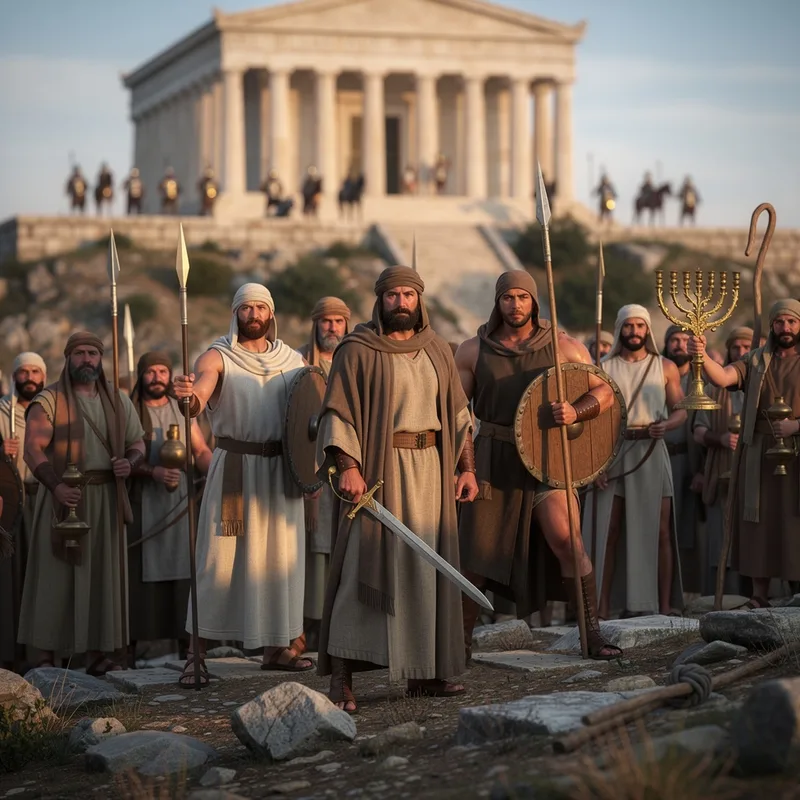
Maccabees
 1
9.1

- proper noun
- /ˈmækəˌbiːz/
- Herzl concluded Der Judenstaat with the battle cry, "The Maccabees will rise again."
Examples
-
Every time the king sent his soldiers into the hills, Judah and the Maccabees jumped out of hiding to surprise the king's army.
Fiction book (1998) -
What do you think about the Maccabees?
-
You are a son of the Maccabees.
Fiction book (1991) -
After the Maccabees had won the war, they returned to their temple and found it in ruins.
Fiction book (1997) -
Under the Maccabees, from 332 to 166 B.C., the Pentateuch once again served as the basis for law and order.
Academic text (1991) -
They have been denigrated for insisting on religious freedom since the time of the Maccabees.
Academic text (2015) -
"Daniel thought of the Maccabees—the Jewish people long ago who fought a war for the freedom to pray.
Fiction book (1997) -
Now, the challenge was to be steadfast to the end, as the Maccabees had been, as St. Maurice had been, as Luther had been at Worms.
Academic text (2005) -
Sara leaned over and whispered, "Guess you'll have to do what the Maccabees did—pray for a miracle."
Fiction book (1997) -
The Maccabees are celebrated for their bravery and leadership during the revolt against foreign rule in ancient Judea.
Surface Forms
Etymology
The word Maccabees comes from a nickname Maccabee, from an old Hebrew word maqqebet meaning 'hammer'. So the name makes you think of them as strong fighters who hit back, which fits their role leading a revolt in ancient Judea.