

Lycaon pictus
- noun
- /laɪˈkeɪɒn ˈpɪktəs/
- South African
- The Lycaon pictus is often referred to as the African wild dog.
Examples
-
Researchers observed a pack of Lycaon pictus coordinating their hunt across the savanna.
-
Researchers observed a pack of Lycaon pictus working together to hunt a wildebeest on the savanna.
-
The population of Lycaon pictus has declined due to habitat loss and conflict with humans.
-
Unlike other canids, Lycaon pictus is known for its strong social bonds within the pack.
-
Many conservationists are concerned about the Lycaon pictus population decline.
-
The Lycaon pictus relies on teamwork to successfully capture prey during their hunts.
-
Conservation efforts are underway to protect the Lycaon pictus from extinction in its natural habitat.
Synonyms
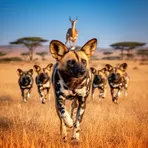
A large wild dog from southern and eastern Africa that hunts in packs
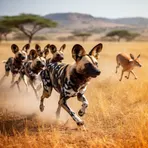
A large wild dog from Africa that lives and hunts in packs

A large African wild dog that lives and hunts in packs
Surface Forms
Morphology
Lycaon + pictus
This is a Latin binomial (taxonomic name) whose constituents are not English words and are not listed in the provided dictionary entries, so a B1 learner who knows common English vocabulary would not be able to derive ‘African wild dog’ from these parts. Scientific names function as lexical labels rather than compositional English phrases, so the meaning is unpredictable without prior exposure or knowledge of Latin/etymology.
Etymology
Lycaon pictus comes from old Greek and Latin words: Lycaon meaning 'wolf' and pictus meaning 'painted'. Early naturalists called it the 'painted wolf' because its colorful, spotted coat looks like someone painted it, so the name fits this spotted African wild dog.

