
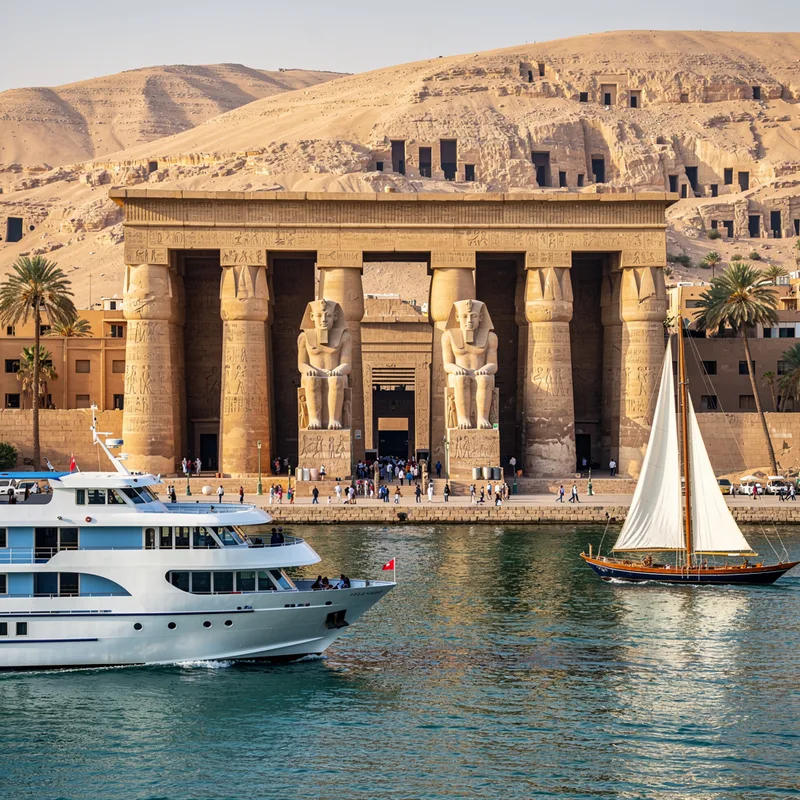
Luxor
 4
5.6

- proper noun
- /ˈlʌksər/
- During the Opet, statues of deities were transported in their boat-shrines between Karnak and Luxor temples.
- Luxor Temple
- Luxor massacre
- arrived at Luxor
Loading YouTube…
Watch on YouTubeYou go to, you go to Karnak and Luxor, for example.
- You go to, you go to Karnak and Luxor, for example.
Examples
-
Exploring and photographing Luxor and Karnak alone would be reason enough to visit Egypt, but our group took it a step farther.
Academic text (2006) -
Many tourists visit Luxor to see the famous temples and tombs of ancient Egypt.
-
I have a house in Luxor, I grew up here.
-
We get back to the Luxor Hotel.
-
We saw his show at the Luxor last night.
Fiction book (1999) -
We leave for Luxor at dawn.
-
The temple at Luxor was the epicenter of the Opet Festival.
Academic text (2002) -
According to legend, upon his arrival in Egypt, Abu el Haggag found Luxor still primarily Christian.
Academic text (2002) -
I wanted an Egyptian perspective, so I went to see Mansour Boraik, director general of antiquities for Luxor, one of Egypt's most important archaeological sites.
-
For 20 years, the Epigraphic Survey of the Oriental Institute at the University of Chicago has worked in Luxor Temple, copying and publishing its inscribed walls.
Academic text (2010)
Synonyms
A city in central Egypt on the east bank of the Nile near the ancient ruins of Thebes
Surface Forms
Etymology
The word Luxor comes from the Arabic al-Uqsur, which means 'the palaces'. The city is full of ancient royal buildings and temples, so Luxor is remembered as the place of palaces, like the English word palace.