
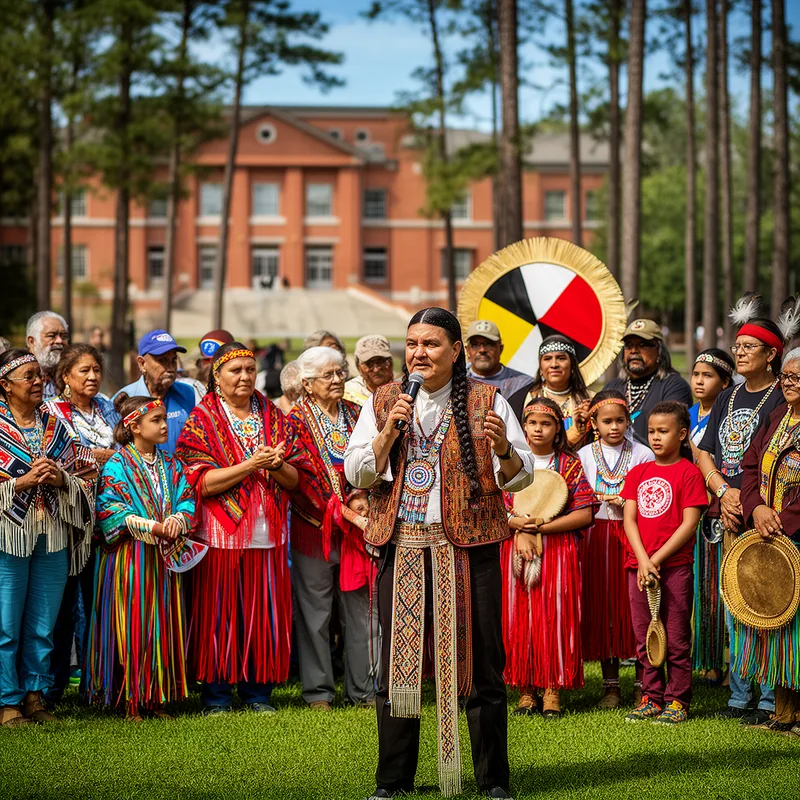
Lumbee


 1
9.9
- proper noun
- /ˈlʌm.bi/
- In 1953, the State of North Carolina recognized the group as "Lumbee," a reference to the nearby Lumber River.
- Lumbee Tribe
- Lumbee community
- Lumbee history
Loading YouTube…
Watch on YouTubeAnd once the search for our teacher became much larger and became about the struggle of the Lumbee people.
- And once the search for our teacher became much larger and became about the struggle of the Lumbee people.
Examples
-
The name chosen was "Lumbee," which was derived from the Lumber River that flows through the county.
Academic text (1995) -
The 1930s saw the growth of factionalism in the Lumbee community.
Academic text (1999) -
On June 7, 2007, the House passed the Lumbee Recognition.
Academic text (2009) -
For example, the Lumbee have lost their native language, and a small percentage have married non-Indians.
Academic text (1991) -
The RBMA was finally ready to serve its function as a boon to the Lumbee community.
Academic text (1999) -
A fatal flaw in the 1956 Lumbee Act kept Indians on the path to seeking recognition.
Academic text (2009) -
As the project began, problems with Lumbee recognition as Indians threatened the resettlement of the Lumbees.
Academic text (1999) -
The Lumbees fought the McNair appointment and eventually succeeded in placing a Lumbee in the manager position.
Academic text (1999) -
The tribal affiliations of these women included: Standing Rock Sioux, Chippewa, Gros Ventre, Arikara, Lumbee, Mohawk, Menominee, and Cherokee.
Academic text (1995) -
The Lumbee tribe has a rich history and culture that is unique to North Carolina.
Surface Forms
Etymology
Lumbee comes from the name of the Lumbee River, also spelled Lumber River, in North Carolina, and the tribe took their name from that river. So a Lumbee is 'a member of the Lumbee people', a Native American group in southeastern North Carolina.